
News & Insights
Pin Insulator, Spool or Shackle?
One pole, three insulator families. Match cantilever strength, flashover level and mounting hardware before you commit a container.
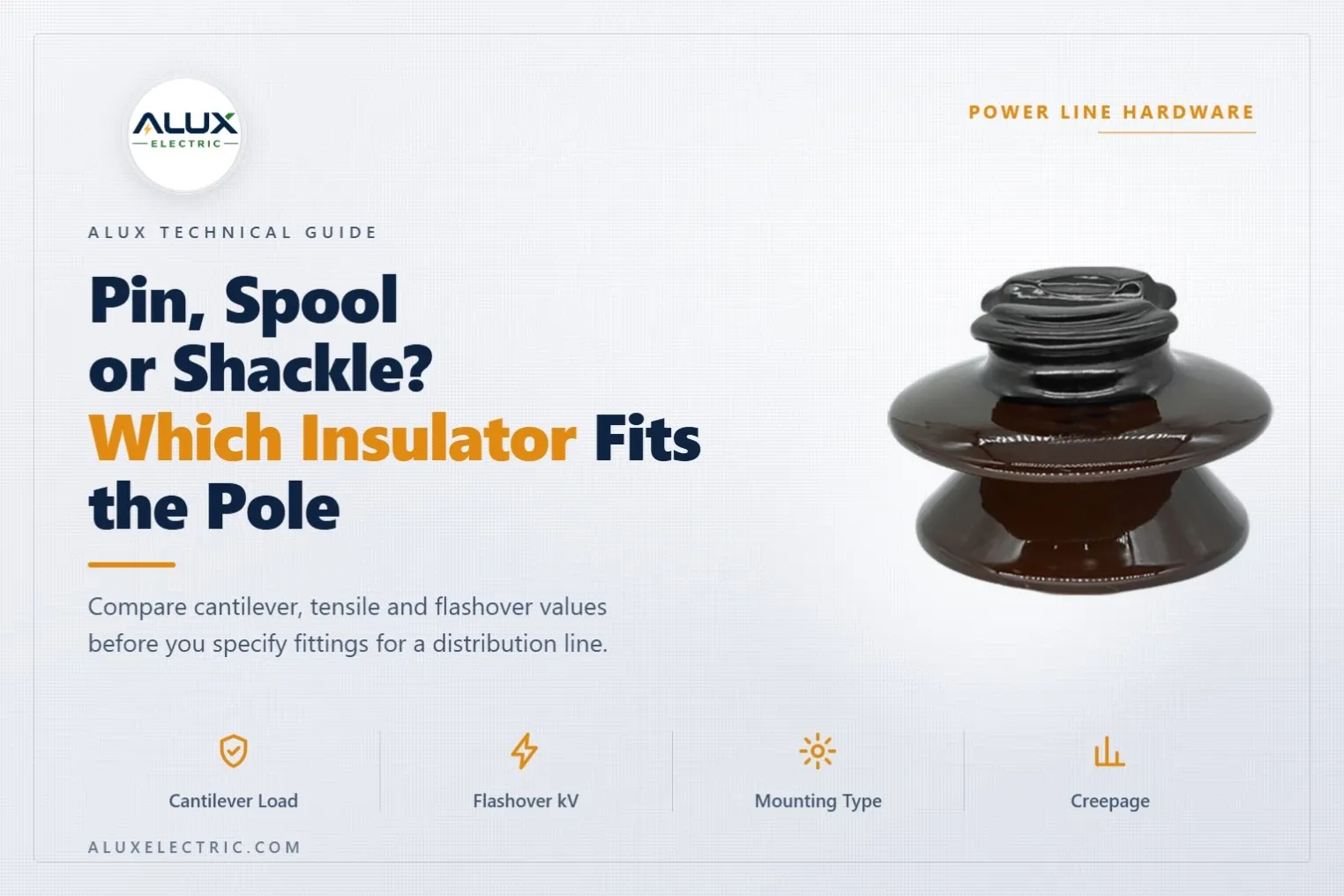
Most pole hardware enquiries start with a photo of a damaged insulator and a request for the price of the same thing. That works until the line is restrung with heavier conductor, or the pole is moved to a corner where the pull changes direction. Then a unit that lasted fifteen years fails in one season. These three porcelain families look alike in a catalogue photo and do completely different jobs.
Three families, three jobs
A pin insulator sits on a steel pin fixed to the cross-arm, with the conductor tied into the top groove by binding wire. It insulates the conductor from the grounded cross-arm and carries the downward and sideways load of the span. This is the workhorse of medium-voltage overhead distribution, and it is the family most buyers mean when they say insulator without qualifying it. Our 56 series follows the ANSI class numbering, from 56-1 upward, with the shed diameter, height and creepage growing as the class number rises.
A spool insulator is a low-voltage device. It bolts to a secondary rack or to the pole itself through a spool bolt, and the conductor is tied into one of its grooves. Its job is to hold low-voltage secondary conductors and service drops apart from each other and from the pole, at the heights and spacings a distribution standard requires. Spools are also used where a service drop changes direction, because the groove lets the conductor be tied off without a sharp bend.
A shackle insulator handles tension. It is used at the end of a distribution line, at a dead-end, or at a sharp turn where the pull on the conductor is high. Ours is a BS-type ED-2B unit, designed to be mounted vertically or horizontally depending on how the stays and conductor run, and it is the part that takes the mechanical load rather than simply holding a conductor in place.
The number that decides the pole
The costliest specification mistake is confusing the direction of the load. A pin insulator is rated by cantilever strength, because the conductor pulls sideways on the pin and tries to bend it. Our 56-1 is rated 11.4 kN cantilever; larger classes sit at 13.6 kN. A spool or shackle is rated by tensile or transverse strength, because the load runs along the conductor and pulls the unit against its fittings. Our 53-1 spool is 9.1 kN, the BS16 shackle 16 kN transverse.
Those two numbers are not interchangeable, and neither is a proxy for the other. A 13.6 kN cantilever rating does not mean the unit can take 13.6 kN of pull along the line, and a 16 kN transverse rating does not mean a shackle can be substituted for a pin on a cross-arm. When a buyer compares a pin and a shackle on headline strength alone, the cheaper unit often looks stronger. On the pole it is being asked to do the wrong job.
Family | Job on the pole | Load direction | Mounting |
Pin (ANSI 56 series) | Support and insulate a conductor on a cross-arm | Cantilever, bending the pin | Steel pin through cross-arm, conductor bound in top groove |
Spool (ANSI 53 series) | Separate and route low-voltage secondary and service drops | Tensile, along the conductor | Spool bolt to secondary rack or pole |
Shackle (BS ED-2B) | Take tension at dead-ends and sharp turns | Transverse, at the termination | Vertical or horizontal, with stay or clamp fittings |
Reading a pin insulator table
Two columns on a pin insulator sheet are routinely confused. Creepage distance is the path a leakage current travels across the wet surface of the sheds, from conductor fitting to pin end. Dry arcing distance is the straight-line air gap between the same two points. Creepage matters in polluted or coastal air, where contamination builds a conductive film; arcing distance matters for impulse withstand.
The electrical columns follow the same logic. Dry flashover is measured clean and dry, wet flashover with the unit sprayed, and the wet figure is always lower and more honest for outdoor service. Puncture voltage is where the porcelain body itself breaks down rather than flashing over. Radio influence voltage, quoted at a test voltage to ground, tells you how electrically quiet the unit runs.
Our class | Diameter mm | Height mm | Creepage mm | Cantilever kN | Dry / wet flashover kV |
56-1 | 191 | 146 | 330 | 11.4 | 95 / 60 |
56-2 | 229 | 165 | 432 | 13.6 | 110 / 70 |
56-3 | 267 | 191 | 533 | 13.6 | 125 / 80 |
56-4 | 305 | 241 | 686 | 13.6 | 140 / 95 |
56-5 | 343 | 318 | 865 | 13.6 | 175 / 125 |
Classes 56-1 and 56-2 are the usual choice for 23 kV class distribution, with 56-1 the lighter at 3.5 kg. From 56-3 upward the shed stack grows fast: 56-3 is a 34.5 kV class unit, and 56-4 and 56-5 reach 686 mm and 865 mm creepage for higher circuits. Do not assume the next class up is right for your line. Work from line voltage, site pollution and available pin height, then confirm the class with us.
Spool and shackle: the cheap unit is the expensive one
The 53 series runs from 53-1 at 57 mm and 9.1 kN to 53-5 at 102 mm and 27.3 kN, with dry flashover climbing from 20 kV to 35 kV and weight from 0.22 kg to 1.20 kg. The range exists because low-voltage secondary work is not one job: a short residential service drop and a heavy bundled run on a commercial corner load the same fitting very differently.
Two notes on the spool range. Our catalogue does not publish creepage for these units, because on low-voltage secondary work flashover values and physical spacing do the work; if a specification calls for creepage, ask us in writing rather than assuming a value. Wet flashover is quoted vertical and horizontal, and the horizontal figure is higher. Fit the spool in the orientation the project assumes.
On the shackle, hold onto 16 kN transverse strength, 64 mm leakage, 25 kV dry and 13 kV wet flashover, 0.50 kg. Compare it with a 53-5 spool at 27.3 kN and you see why strength alone is a poor selector: the spool is stronger in its own axis and still cannot do a dead-end job, because the fittings suit a different duty.
What belongs on the purchase order
Five items prevent most returns. State the class designation, not a description, so 56-1 cannot be read as any pin insulator of about the right size. State the system voltage, plus the pollution level if the line runs near coast or industrial fallout. State the load direction and the calculated value, so the rating can be confirmed rather than guessed. State the mounting hardware, because pin diameter, pin height and spool bolt size must match the pole. Then the glaze colour and marking, which are fixed at the factory.
Ask for routine test reports with the shipment. The class numbering is a dimensional and rating convention - pin family in ANSI C29.6, spool in C29.3, guy strain in C29.4 - but a class number on a carton is not proof of the test. Our units ship with ratings and test reports on request, and we would rather send the report before the order than discuss it after an inspection.
Where this fits with the rest of the line
Pole hardware rarely gets specified alone. The same projects usually involve outdoor connectors and enclosures, where ingress protection decides how long the joint survives, and industrial plugs and sockets whose colour band tells you the voltage and frequency at a glance.
Next step
Send us the line voltage, the class you are replacing, and a photo of the pole fitting, and we will come back with the matching class, the load rating and the hardware in one reply. We supply pin, spool and shackle families factory-direct with private marking and container-load terms, and we can quote mixed containers across the range. Reach the team at /contact-us/ or message us on WhatsApp for a faster answer.