Oct 20, 2026News & Insights
IEC 60309 Colour Codes: Voltage & Pins
What IEC 60309 housing colours and earth-contact clock positions actually mean, and how to match plugs to local voltage before you place a factory order.
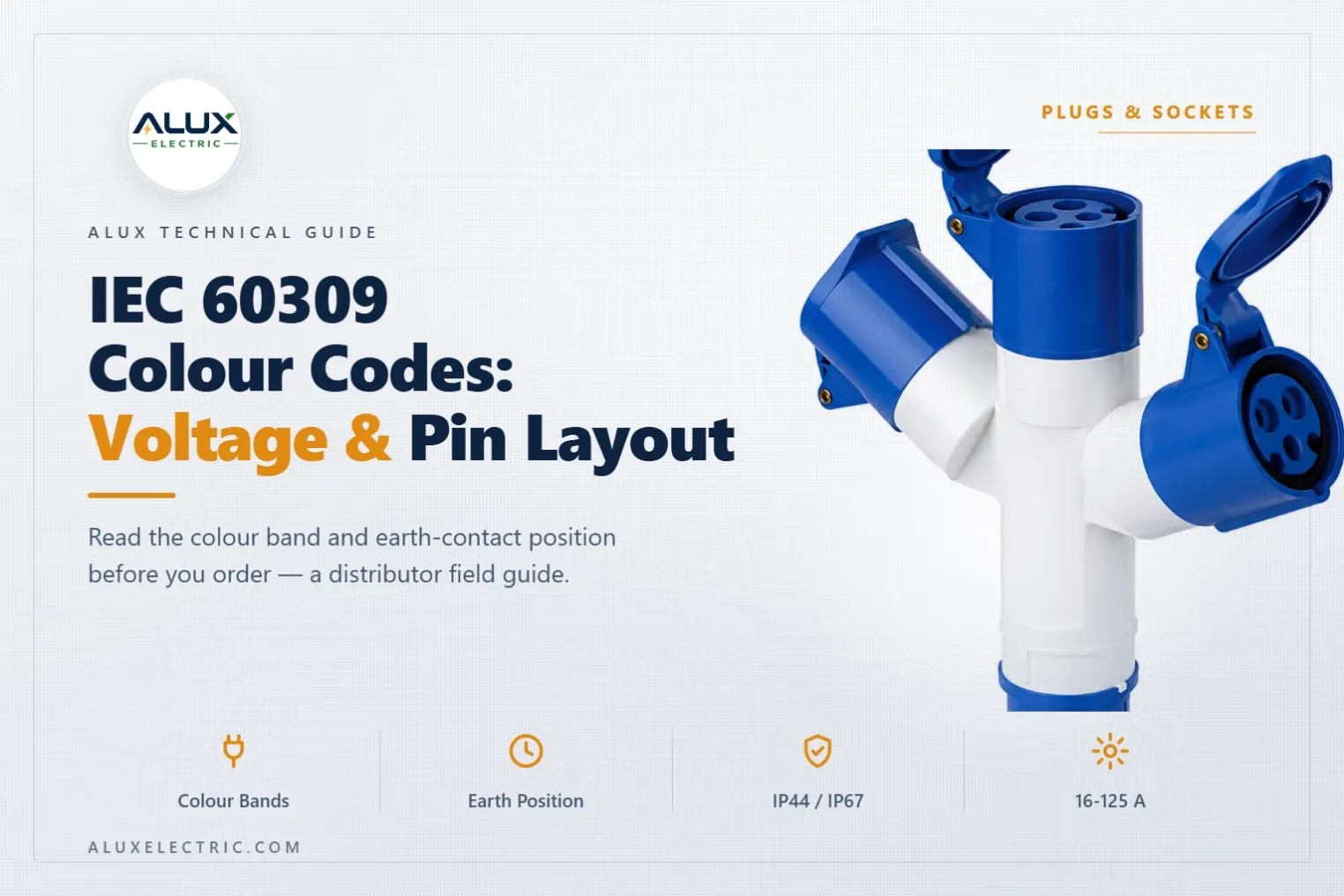
If you have ever opened a pallet of industrial plugs and wondered why one 16 A unit is blue, the next red and a third yellow, the answer is not branding. Under IEC 60309-2, the housing colour tells you the rated operating voltage band, and the angular position of the earth contact fixes the exact voltage, frequency and pole arrangement. Read both correctly and you will never ship a 230 V plug into a 400 V three-phase project.
Why the colour code exists
Plugs and sockets in the IEC 60309 family all look similar: a rounded body, a keyed shroud and a thick earth pin. Because the housing shape alone does not reveal the voltage, the standard assigns a colour to each rated voltage band, so anyone on site can tell at a glance whether a plug is safe to pair with the socket on the wall. For distributors the colour is also a stock-keeping aid: you can audit a shelf of mixed stock without reading a single rating plate.
The six main colour bands
The colour code runs from extra-low voltage control circuits up to 1000 V networks. The bands you meet most often in export business are yellow, blue and red:
Rated operating voltage | Housing colour | Where you meet it |
20 - 25 V | Violet | Extra-low voltage control circuits, 24 V tools |
40 - 50 V | White | Extra-low voltage portable tools and site lighting |
100 - 130 V | Yellow | 110 V construction-site supplies and similar networks |
200 - 250 V | Blue | 230 V single-phase mains circuits |
380 - 480 V | Red | 400 V three-phase supplies (commonly 380 - 415 V) |
500 V and above | Black | Heavy industrial networks, commonly 500 - 690 V |
Two further colours exist for narrower cases. Green is used for higher-frequency supplies rather than for a voltage band - manufacturer catalogues list it for roughly 60 - 500 Hz applications, for example 115 V 400 Hz aircraft power. Grey is allocated to 277 V 60 Hz circuits in the Series II ratings used mainly in North America. Neither should be treated as a free choice of colour for a standard 50 Hz industrial project.
The earth-contact clock position
Colour alone is not enough, because one colour band still covers several voltages and pole arrangements. IEC 60309-2 therefore keys each combination mechanically: the larger earth contact sits at one of twelve clock positions, spaced at 30 degree intervals and measured looking into the socket face. Because the earth pin is thicker than the current-carrying pins, a plug physically cannot enter a socket whose keying does not match. For the common 16 A and 32A ratings, the combinations you will quote most often are:
Pole arrangement | Rated operating voltage | Colour | Earth contact |
2P+E (single phase) | 100 - 130 V | Yellow | 4h |
2P+E (single phase) | 200 - 250 V | Blue | 6h |
2P+E (single phase) | 380 - 415 V | Red | 9h |
3P+E (three phase) | 200 - 250 V | Blue | 9h |
3P+E (three phase) | 380 - 415 V | Red | 6h |
3P+N+E (three phase + neutral) | 120/208 - 144/250 V | Blue | 9h |
3P+N+E (three phase + neutral) | 200/346 - 240/415 V | Red | 6h |
3P+N+E (three phase + neutral) | 347/600 - 400/690 V | Black | 5h |
The pairing that trips people up most often is the red one. A red 4-pin 3P+E plug at 380 - 415 V is keyed at 6h, while a red 5-pin 3P+N+E plug at the same voltage is also keyed at 6h - but blue reverses it: blue 2P+E sits at 6h while blue 3P+E and blue 3P+N+E sit at 9h. Colour and pin count together tell you nothing until you have read the clock position as well. Frequency matters too: a 60 Hz 440 - 460 V supply is keyed at 11h, so a plug of the same red colour will not mate with a 50 Hz unit. Confirm the position against the manufacturer's current table for the exact rating before you place a factory order, particularly above 32 A, where some combinations are not standardized.
What to check before ordering
Colour and keying are two of four things to confirm. Run through the full list every time: rated current (16 A, 32 A, 63 A or 125 A), rated operating voltage band and its colour, the earth-contact clock position for your voltage and frequency, and the ingress protection rating you need. Finish with the cable gland range, so the cord your customer uses actually fits the entry.
The most common mix-ups
Three mistakes account for most returns and site complaints. First, yellow versus blue: a 110 V site-safety plug looks much like a 230 V plug, and they must never be interchanged - that is precisely why their keying differs. Second, treating black as a generic option: black means 500 V and above, not a spare colour for whatever happens to be in stock. Third, ignoring frequency variants in 60 Hz markets: a 440 - 460 V 60 Hz unit is keyed at 11h, so even a correctly coloured plug may refuse to mate with the local socket.
Stocking advice for distributors
If you are building stock for mixed export markets, start with the combinations that cover most industrial sites: blue 2P+E 6h and blue 3P+N+E 9h for 230 V single-phase and 120/208 - 144/250 V circuits, plus red 3P+E 6h and red 3P+N+E 6h for 400 V systems - all in 16 A and 32 A. Add yellow 4h units only where customers serve 110 V construction-site supplies. That core keeps inventory shallow while covering the widest range of projects. Check it against our comparison of cam-lock and IEC 60309 connectors before you commit to a full range, and use our specification guide for IEC 60309 plugs and extension leads when you write the tender.
One practical note for buyers comparing keying against mechanical interlocks: the two families serve different jobs, and the choice usually comes down to whether the site needs a single-pole high-current connection or a keyed multi-pole outlet.
Where to go next
Our ALX-0086 industrial plug and socket is a 16 A unit in the 200 V band (blue) with an IP67 rating - a typical workhorse for outdoor and washdown single-phase circuits. Send your requirement list with the target market voltage and frequency and we will confirm the correct colour band and clock position before quoting. For quick questions, message us on WhatsApp.
Checked against IEC 60309-2 tables published by MENNEKES (Table 210) and the IEC 60309 pin-configuration tables, plus industrial plug catalogue colour-coding to BS EN 60309-2. Always verify against the datasheet of the exact part you are ordering.