Oct 20, 2026News & Insights
IP44 vs IP67: Higher Isn't Safer
IP44 and IP67 are not rungs on one ladder: splash, jet and immersion are separate tests. Match the code to the site, not to habit.
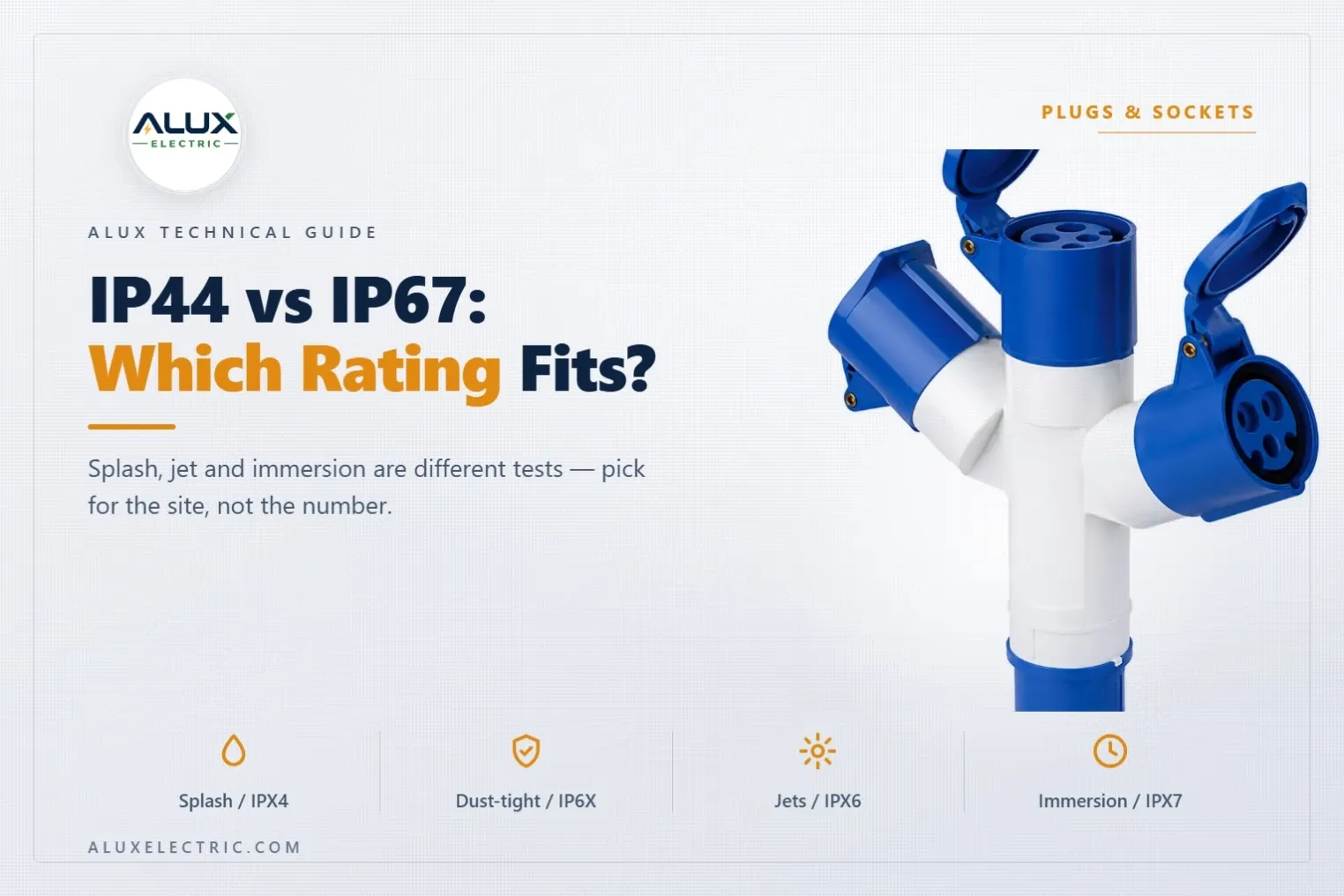
The most expensive IP rating mistake is not picking too low a number. It is assuming the numbers form a ladder, so that a higher one automatically covers everything below it. They do not. Under IEC 60529, splashing, jetting and immersion are different tests with different rigs, and a connector rated for immersion has not necessarily been qualified against a jet. This guide explains what the two digits actually certify, where IP44 and IP67 each earn their keep, and how to write the requirement so it survives a site inspection.
How to read the two digits
An IP code is written as IP followed by two characteristic digits. The first covers protection against solid objects and access to hazardous parts; the second covers protection against water. An X in either position means that characteristic has not been declared in the designation - it does not mean the protection is zero, and it does not tell you whether any separate testing was done. If a datasheet shows IPX7, ask what the dust rating is before you compare it with IP67.
First digit | Protection against solids |
4 | Objects larger than 1 mm - wires, small tools, coarse grit |
5 | Dust-protected: limited ingress allowed, no harmful deposit |
6 | Dust-tight: no ingress of dust |
The second digit is where buyers get caught out, because the tests are not cumulative:
Second digit | Protection against water | What the test actually is |
4 | Splashing water from any direction | Oscillating spray rig |
5 | Low-pressure water jets from any direction | 6.3 mm nozzle, around 12.5 litres per minute |
6 | Powerful water jets from any direction | 12.5 mm nozzle, around 100 litres per minute |
7 | Temporary immersion | 1 m depth for 30 minutes, static pressure |
8 | Continuous immersion | Conditions specified by the manufacturer |
9 | Close-range high-pressure, high-temperature jets | Dedicated high-pressure hot-water rig |
The trap: jets and immersion are not the same test
Digits 5 and 6 apply dynamic pressure from a nozzle, from any direction. Digit 7 applies static pressure with the unit fully submerged in still water. These are different failure modes: a seal that holds against standing water can still be forced open by a directed jet, and a housing that shrugs off a jet is not automatically sealed for immersion.
The practical consequence is worth stating plainly: a connector marked IP67 has not necessarily been tested against powerful jets, so IP67 does not automatically mean it is suitable for high-pressure washdown. If your customer's site washes equipment down with a pressure washer, the requirement to specify is the jet rating - IP66 - not the immersion rating. Where both matter, ask the supplier to confirm both tests were carried out, and get it in writing.
The same caution applies to IP68. Its immersion conditions are defined by the manufacturer rather than fixed by the standard, so IP68 on one product is not directly comparable with IP68 on another. Compare the stated depth and duration, not just the code.
Where IP44 is the right choice
IP44 - protected against objects over 1 mm and against splashing water from any direction - is the workhorse rating for indoor and sheltered industrial work: workshops, assembly areas, factories with covered loading bays, and any location where the connector may be splashed but is not being hosed down. It is also the easier product to live with: the sealing arrangements are simpler, termination is faster, and the units generally cost less. Specifying IP67 here buys nothing the site needs and adds cost to every unit on the project.
Where IP67 earns its cost
IP67 - dust-tight plus temporary immersion at 1 m for 30 minutes - is the right call where the connector will be exposed to standing water, heavy weather, washdown, burial in a pit, or temporary flooding: outdoor sites, marine and dockside installations, food and beverage plants, agriculture, and any pit or trench that can fill with water. It is also the sensible default where a connector sits at or near ground level and nobody is checking on it daily.
Two things come with it. The sealing is more elaborate, so termination takes longer and has to be done properly - including the cable gland, which is the most common leak path. And the seals are consumable in the long run: on washdown sites, plan for inspection and replacement rather than assuming fit-and-forget.
What to write into the enquiry
Question | Why it decides the rating |
Is it indoors, sheltered or fully exposed? | Splashing alone usually points to IP44 |
Will it be hosed or pressure-washed? | That is a jet requirement - confirm IP66, not just IP67 |
Can it be submerged, even briefly? | Standing water or flooding points to IP67 |
Is dust or fine grit present? | Heavy dust pushes the first digit to 6 |
Who terminates the cable, and how? | The gland is the usual leak path on any rating |
Is there an inspection regime? | Seals are service items on washdown sites |
Ask for the rating to be confirmed against the specific part number you are buying, on the product's datasheet or marking plate, rather than accepting a range-level claim. Ratings apply to a mated pair under the test conditions - an unmated plug or a cap left off is not rated at all.
The mistakes that turn into returns
Three come up repeatedly. First, treating the code as a ladder and specifying IP67 where the real exposure is a pressure washer. Second, comparing IP68 figures between suppliers without comparing the depth and duration behind them. Third, ignoring the cable gland and the mating: a correctly rated connector installed with the wrong gland, or left unmated on site, fails at the first opportunity regardless of what the housing is marked.
Next step
Tell us where the connector will live - indoors, sheltered, exposed, washed down or liable to flood - and we will confirm which rating fits and which tests back it, before you commit to a range. If you are still deciding between connector families, start with the comparison above and then match the colour band and keying for your market voltage.
Talk to our team on the contact page: /contact-us/ - or message us on WhatsApp for a faster reply.