
News & Insights
How Industrial Plugs Are Made & Checked
Baskets, assembly benches, a sealing machine - what an industrial plug order passes through on the line, and six checkpoints to confirm before it ships.
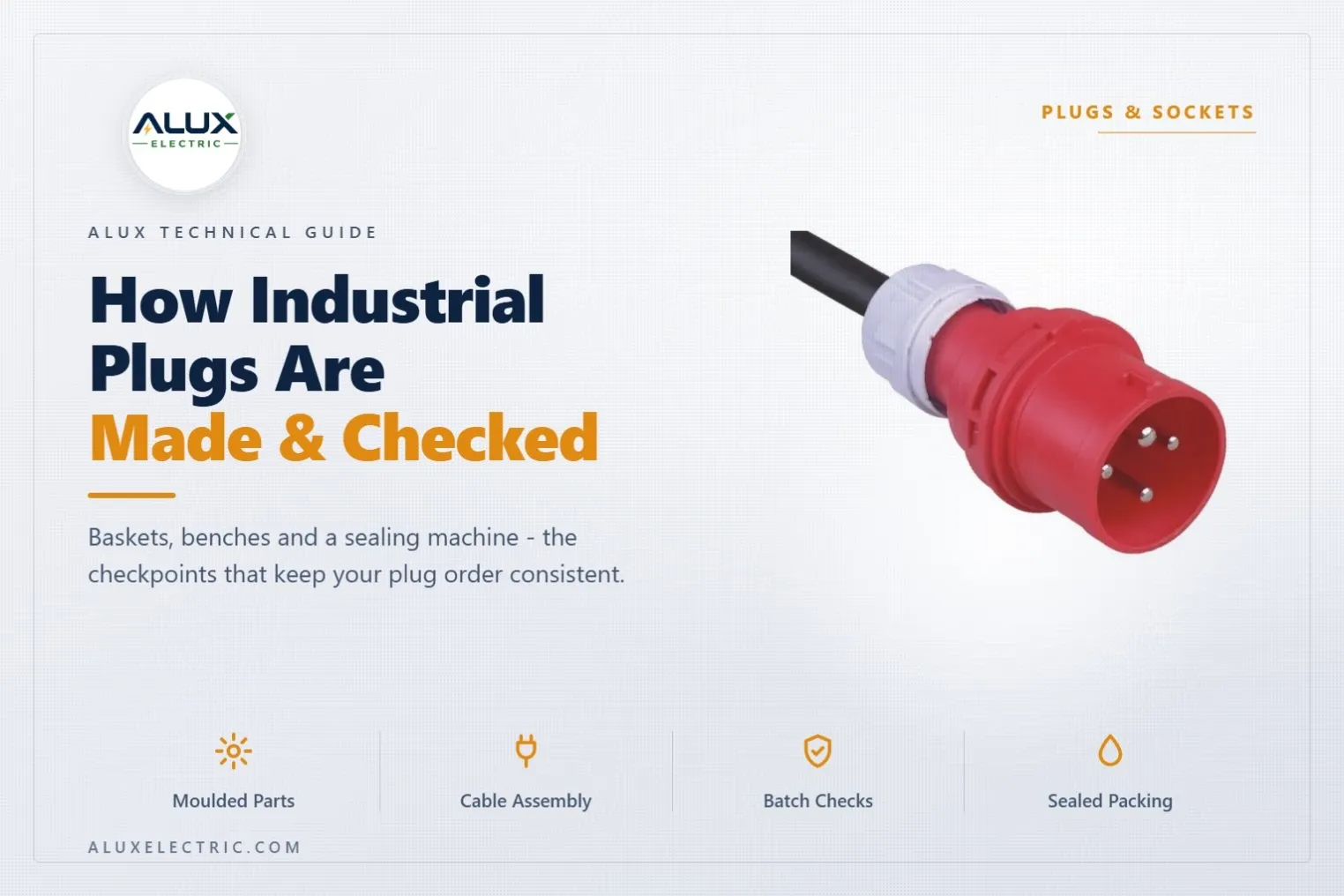
Most buyers meet an industrial plug twice: once in the catalogue and once in the carton. Between those two moments sits a production line, and what happens there decides whether the pallet you receive matches the sample you approved. This article walks through the stages you would see on an ordinary plug line - moulded parts arriving in baskets, cable assembly at the benches, and an automatic bagging machine at the end - then lists the checkpoints worth confirming with any supplier before you release an order.
From basket to bench to bag
The line starts with mouldings. Housings, backs and gland bodies are moulded in batches and moved to the assembly area in stackable baskets, sorted by part and colour. Because housings for different voltage ratings are the same shape apart from the colour band and the keyway, the baskets are where the first mixing risk sits: one basket holds blue 200-250 V backs, the next holds red 380-415 V. Assembly pulls from whichever basket is in front, so the baskets have to be labelled and separated by more than habit.
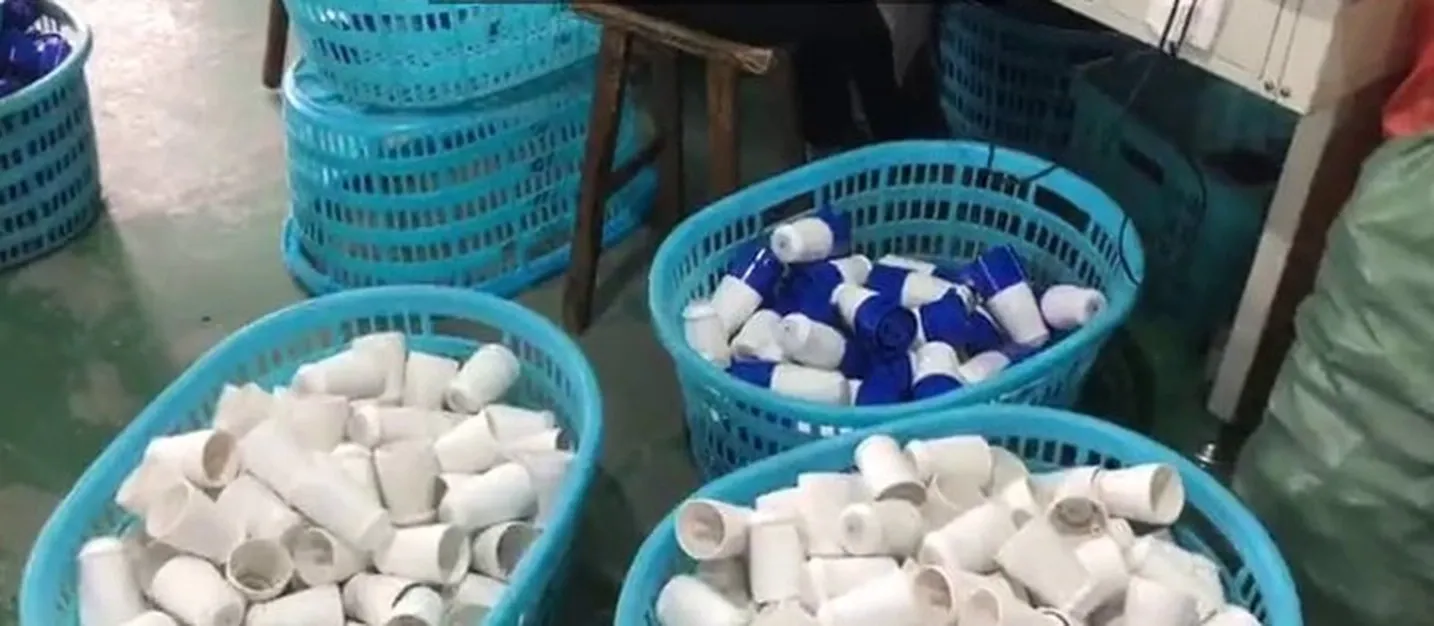
Next is assembly. At the benches, contacts are seated in the face, the cable gland and strain relief are fitted, and cable is terminated for cord-set versions. Two details at this stage matter more than they look. The first is contact plating - a scratched or tarnished contact surface raises contact resistance and heats the connection in service. The second is gland clamping: the gland has to close properly on the cable diameter you actually use, or the strain relief fails and the IP rating at the entry is gone.
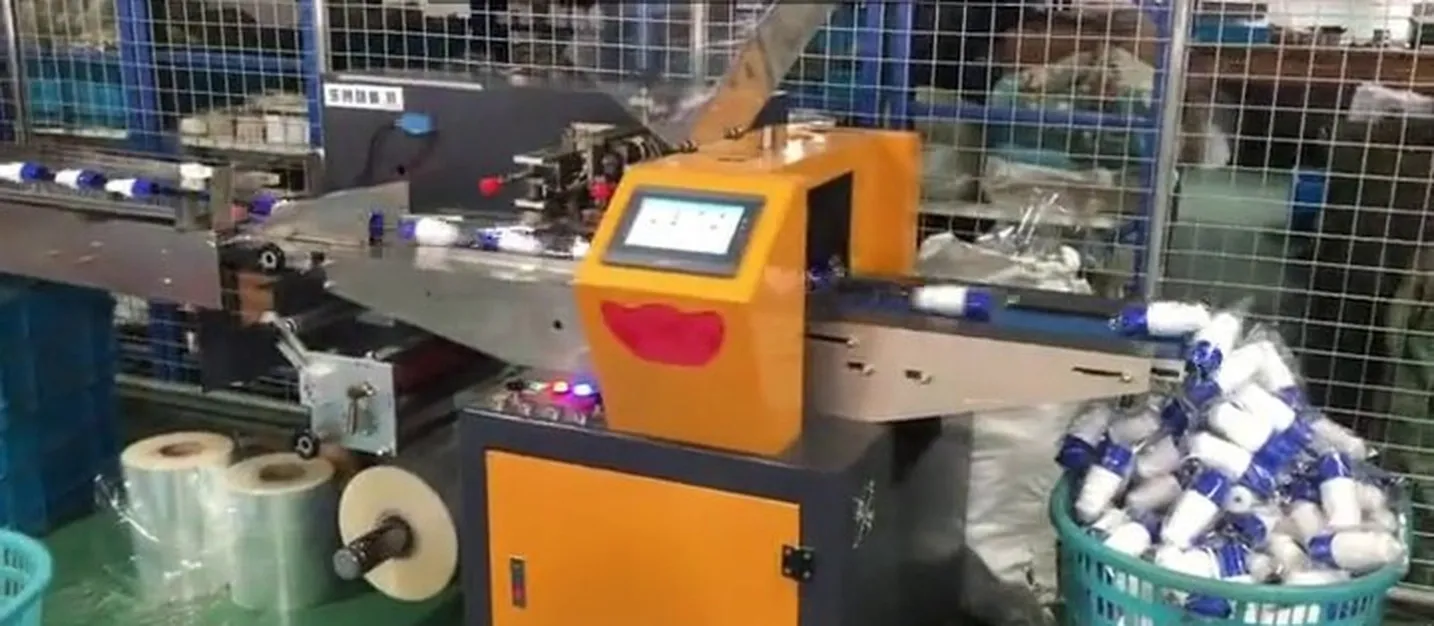
The last station before packing is bagging. Finished units travel down a conveyor into an automatic sealing machine that wraps each unit in polyethylene film. Sealed bags collect in bins, bins go into cartons, and cartons go onto the pallet. The photo below is from our own line at ALUX - the orange machine is the sealer.
Why the bagging station matters
An individually sealed bag sounds trivial, but it answers two real problems for an importer. The first is transit: plugs sit in containers for four to eight weeks through humidity swings, and an unbagged housing accumulates dust and condensation marks before it ever reaches a shelf. The second is order integrity: the bagging bins are where two part numbers are most likely to meet. A supplier who seals every unit individually almost always has the bins and carton labels under control as well; a supplier who ships loose units in a master carton is telling you something about the rest of the process. So when you audit a factory - in person or on video - spend a minute at this station.
What to look for in a line video
Since a visit is not always practical, most of this auditing happens over video, and a ten-minute clip tells you more than a certificate folder. Watch the baskets first: they should carry labels that name the part, not just the colour, and one basket should serve one part number. Watch the benches next - a bench with the right jigs and a printed work instruction produces the same plug all day; a bench with loose parts and no paper produces whatever the shift remembers. At the sealer, look at the edge of the finished bag: a consistent, flat seal means the machine is set and left alone, while wavy seals mean the operator is chasing the temperature all shift. Finally, ask for one shot of the carton labelling against the packing list. A supplier who sends that shot unasked has usually already fixed the problems you would have found by asking.
Six checkpoints before you release the order
None of the checkpoints below requires a laboratory. They are questions you put in the enquiry and verify against photos from your actual batch, not from the showroom.
Checkpoint | What to ask | What bad looks like |
Marking | Is the voltage and ampere rating moulded or heat-stamped into the housing, not on a label? | A paper label that peels or fades after one season outdoors |
Colour code | Does the colour band follow IEC 60309 for your voltage system, consistently across the batch? | Two band colours inside one carton of the same order |
Cable entry | Which gland sizes and cable cross-sections does the entry take, and does the clamp close on your cable? | A gland that cannot seal the cable you actually run |
Contacts | Plating condition and contact surface, sampled from several cartons | Scratched or tarnished contacts inside the sealed bags |
Ingress protection | Which IP rating does the design carry, and what environment is it really for? | An immersion-grade claim on what is visibly a splash-proof build |
Packing | Sealed bag per unit, carton spec, and carton marking that matches the purchase order | Loose units mixed in a master carton with no batch marking |
On sampling: ask for photographs from three cartons picked at random from your production batch - housing marking, contact face, gland, and the sealed bag with the label. Photos of a pre-production sample prove the sample was good; photos from the batch prove the order is good. The two are not the same document.
What factory-direct changes
Buying factory-direct does not remove any of these checkpoints - it changes who you can ask. A trading company relays your question; a factory can answer it against the line, and can send you the kind of footage this article is illustrated with: baskets, benches, the sealer running. That feedback loop is the main reason distributors who switch to direct sourcing keep the habit - pricing is only part of it. We covered the commercial side in our earlier piece on why buyers choose factory-direct plugs; this article is the quality side of the same decision.
Next step
Send us the amperage, the voltage system, the environment the plugs will work in and the cable you plan to run, and we will confirm the colour code, gland sizing and packing format against your order before production starts. If you would rather see the line first, ask - we will send batch photos or a factory video the way the ones in this article were shot. Reach our team at /contact-us/ or message us on WhatsApp for a faster reply.