
News & Insights
Why Buy Industrial Plugs Factory Direct?
From automatic assembly to batch packing: what factory-direct industrial plug production looks like, and the checks that protect your order.
Factory-direct pricing is easy to advertise and harder to audit. When a plug arrives with the wrong pin configuration, or a batch arrives two shades off from the last one, the discount you negotiated disappears into rework and waiting. The photographs in this article were taken on our assembly line: plug bodies and contacts in production batches, an automatic assembly machine doing the repetitive work, and operators checking output between stations. They are quick snapshots, but they show the part of the supply chain a catalogue never shows - and it is the part that decides whether a container of industrial plugs lands clean or lands as a problem.
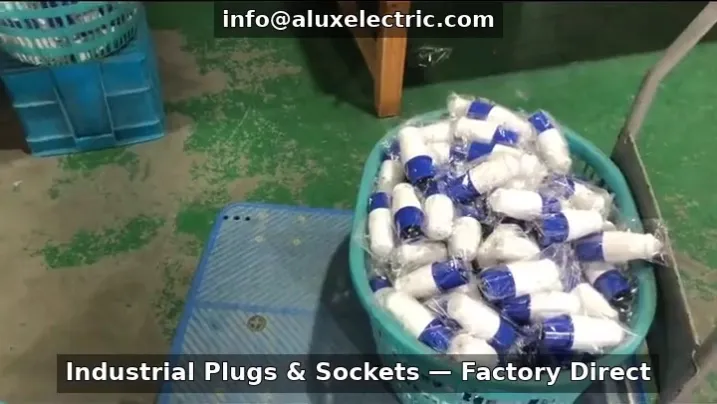
Finished industrial plugs in production bins - each basket carries one voltage family, not a mix.
Inside the assembly line
An industrial plug is a small assembly with a lot of parts: housing, contact carrier, terminals, screws, cable gland and seal. On the line these arrive as components and move between stations in washable bins, one colour per stage. The automatic machine handles the steps where repeatability matters - contact seating and screw torque drift when done by hand all day - while operators feed components, watch the output and pull samples from the bin as the batch runs. Nothing exotic; it is disciplined batch work. What matters to a buyer is that the same hands, machines and bins produce the first sample and the last carton of the order.

Automatic assembly station: contacts and screws set by machine, with operators sampling output between batches.
That is also why batch discipline shows up in the finished goods. On the line, completed plugs collect in colour-sorted baskets: blue bodies in one, red in another, each bin one voltage family. When a factory keeps batches separated like this, mixed cartons and swapped ratings become rare. When a supplier tolerates mixed bins, that is where 230 V and 400 V parts quietly trade places.
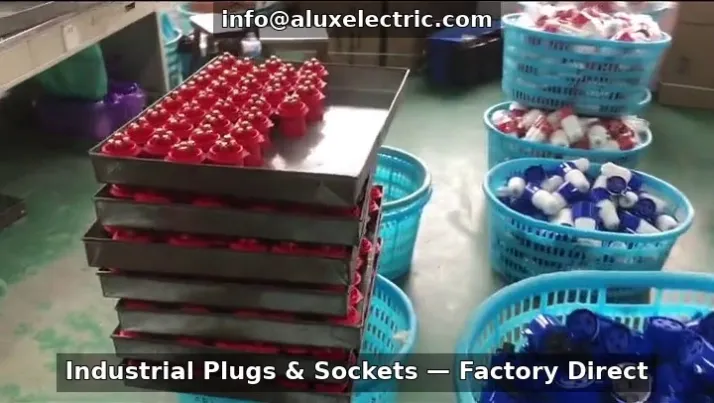
Red and blue bodies kept apart on separate trays and baskets - batch colour separation, not sorting after the fact.
Colour is the first specification
On IEC 60309 plugs the colour band is not decoration - it is the voltage rating made visible. Blue covers 200-250 V systems and red covers 380-415 V, with the earth-contact clock position separating the pin configurations inside each family. A warehouse crew that has never read a datasheet can still pick the right plug off a shelf if the colour discipline holds. We keep the full table, including the configurations that trip up even experienced buyers, in our IEC 60309 colour-code guide - worth reading before you fix the mix for your market.
The colour system only protects you if the factory keeps colours consistent. A plug moulded in the wrong shade of blue is still legally blue to a forklift driver, so colour tolerance is a production question, not just a design one. This is one of the checks worth doing on a sample, not in an email.
The rating you can see, and the one you can't
Amperage is printed on every industrial plug: 16 A, 32 A, 63 A and up. The number that matters, though, is the rating of the whole assembly. A cord connector, a plug and a cable gland each carry their own rating, and the finished set is only as strong as the lowest one. The same trap appears in cord sets, where the plug on the end caps the conductor inside - a mistake that shows up in extension cords just as it does in plugs.
Pin configuration is the other quiet failure. A 2P+E and a 3P+E plug in the same colour family are not interchangeable, and neither are the 3P+E and 3P+N+E positions at the same voltage. We covered that trap, and the clock-position code behind it, in our 200 V vs 380 V guide.
Match the ingress rating to the site, not the brochure
IP44 and IP67 both appear in industrial plug catalogues, and both are correct - for different sites. IP44 keeps out splashes and small bodies; IP67 survives immersion. Paying for IP67 on a dry indoor distribution board is waste, and specifying IP44 on a wash-down floor is a leak waiting to happen. The tests behind the two codes are different in kind, not degree, which we explain in our IP44 vs IP67 comparison.
What batch production means for your order
For a distributor, batch discipline is not a factory-floor detail - it is what your customer sees. Consistent batches mean the plug you sold last quarter matches the plug you sell today, so installed bases stay serviceable and spare-part continuity holds. They also make mixed containers workable: when every batch is sorted and labelled, loading 16 A blue, 32 A blue and 16 A red into one container stops being a sorting gamble.
The reverse is also true. If a supplier cannot tell you which batch an order ships from, or the moulded marking changes shape between samples, expect that inconsistency to reach your customers eventually - usually in the order where you can least afford a claim.
Questions to put in a factory-direct enquiry
Question | What it protects |
Voltage system and pin configuration? | Colour band and earth-contact position match your market |
Which IP rating does the housing carry? | Site-appropriate sealing - and the right price |
Cable gland range? | The conductor sizes your customers actually terminate |
Moulded or label marking? | Legibility after years on site |
Which approval documents apply to our market? | Certificates that match the offer - check the standard number and rated values before the container, not after |
Samples before the container? | Colour, pins, gland fit and marking verified in your hands |
None of these questions is complicated, and a factory that controls its own line answers them without hesitation. Hesitation itself is information: it usually means someone is passing your enquiry downstream, which is exactly what factory direct is supposed to remove.
From the line to the container
The last metres of the line matter as much as the first. Finished plugs are packed per model, cartons are labelled with the configuration, and mixed-model containers are loaded against a packing list. Confirm carton quantity, pallet size and label language before the order leaves - those details cost nothing to fix in an email and a fortune to fix in a warehouse.
Next step
Send us your voltage system, amperage, IP rating and gland size, and we will quote the configuration back with the marking and packing details spelled out. If this is a first order, start with a sample set - colours and pin layouts are things you should check in your hands, not in a pro-forma invoice. Reach our team at /contact-us/ or message us on WhatsApp for a faster reply.