Sep 19, 2026News & Insights
# Why Your Industrial Plugs Keep Burning Out (It's Usually Not the Plug)
Industrial plugs burn from wrong selection, not bad quality. Learn 4 mistakes: current rating, poles, IP rating, cable — and pick the right one.
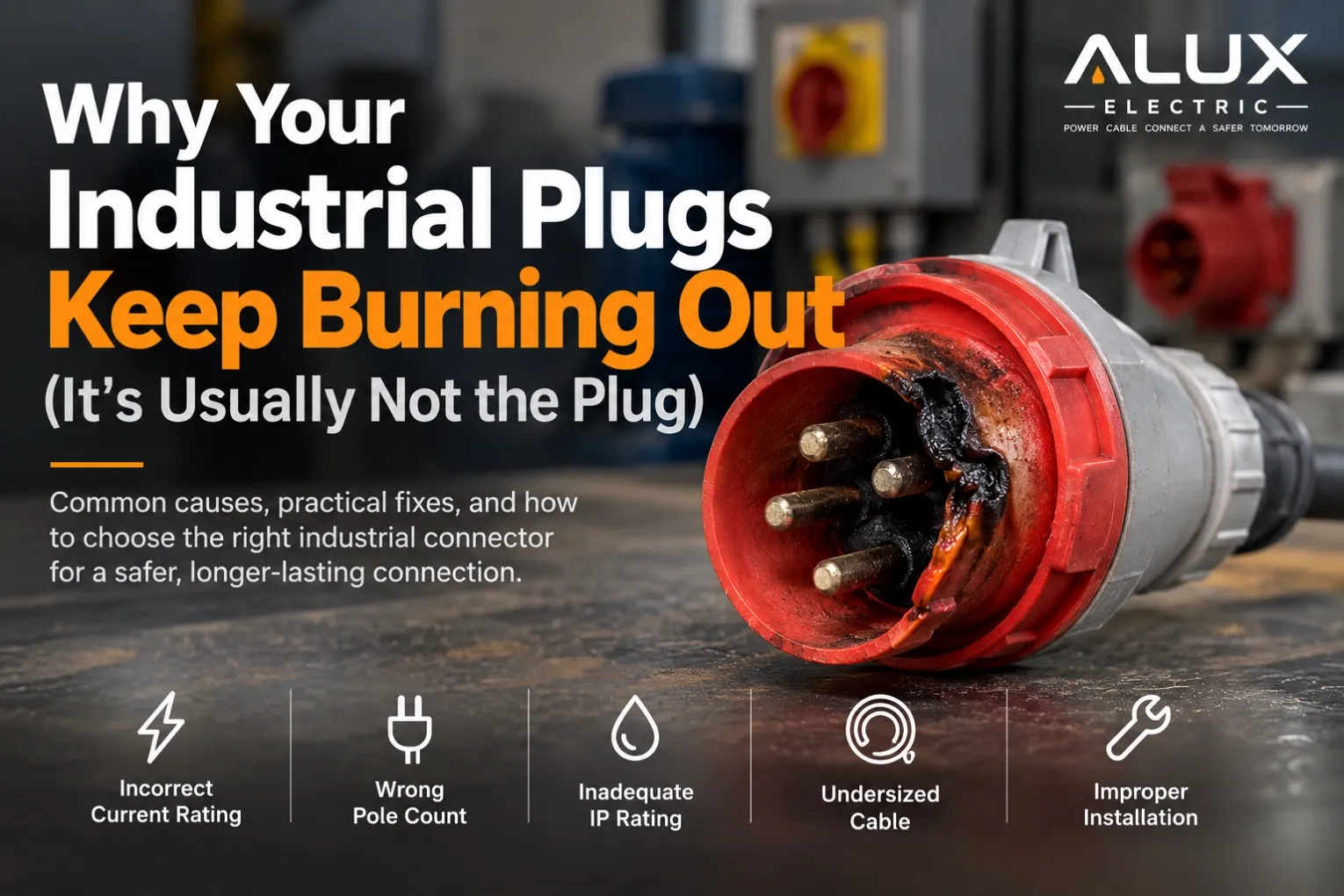
Why Your Industrial Plugs Keep Burning Out (It's Usually Not the Plug)
Walk into most workshops and you'll see at least one industrial plug with brown marks, a burnt smell, or melted pins. Most people blame the plug — "bad quality." But 9 times out of 10, the plug is fine. Someone just picked the wrong one.
This article covers the 4 common mistakes when choosing an industrial plug, and what to tell your supplier so you get the right part.
Heat is the real problem
A plug gets hot when current passes through a contact that is too small or not fixed tightly. The hotter it gets, the more the metal wears out, and the more heat builds up. In the end, the contacts melt.
So when a plug burns, don't ask "is it a bad plug?" Ask "why did it get hot?" Usually it's one of these 4 mistakes.
1. Current rating too low
This is the most common mistake. The plug's current rating must be higher than your machine's real current — with some extra margin.
If a machine uses 28 A and you put it on a 16 A plug, the plug runs over its limit every day. It will burn, sooner or later.
A simple rule: pick a plug rated at least 25% higher than the machine's current, then choose the next standard size (IEC 60309). A 28 A load needs a 32 A plug, not 16 A. If the machine has a strong start-up current, use 63 A.
2. Wrong number of poles
Poles are not something you can ignore. Single-phase, three-phase, and "with neutral" are different plugs. The pins only fit one way for a reason.
- 2P+E — single phase + earth, 220–250 V. For tools, lights, small machines.
- 3P+E — three-phase, no neutral, 380–415 V. For motors, big machines.
- 3P+N+E — three-phase with neutral, 380–415 V. For loads that need neutral.
If you pick wrong, you don't just get heat — you get shock risk. Always check your power supply before you order.
3. Wrong IP rating for the place
IP rating shows how well the plug keeps out dust and water. Two types are common:
- IP44 — keeps out dust over 1 mm and water splash. Good for dry indoor use.
- IP67 — fully dust-proof and water-tight. Good for outdoor, wet, or dusty areas.
If you use a low-IP plug in a dusty or wet place, dirt and water get inside. The contact gets worse, the plug heats up, and it fails. Simple rule: if it's outside or wet, use IP67.
4. Cable too thin for the plug
The plug is not the only thing that matters. A burnt plug is often killed by the cable. If the cable is too thin, it gets hot under load, and that heat goes into the plug.
Use a cable that can carry the same current as the plug, and use a gland that seals the cable. Don't put a 63 A plug on a cable that only handles 32 A.
Bad installation also burns plugs
Even a good plug burns if installed badly. The most common case: the screws are not tight, so the wire sparks and heats at the joint. Loose strands or a bad gland cause the same problem.
Before you turn on power: tighten the screws, check no wire strand is loose, and make sure the gland seals the cable. It takes 30 seconds and saves a burnt plug.
5 things to check
Item | Check | Why |
Current | Load × 1.25, round up | Avoid overload |
Poles | 1-phase / 3-phase, neutral? | Avoid wrong wiring |
IP rating | Dusty? Wet? Outdoor? | Keep contacts clean |
Cable size | Same as plug rating | Stop cable heat |
Install | Tight screws + good gland | Stop sparking |
Price should be last on this list. A wrong plug costs more in downtime than the money you save.
What to tell us before we quote
To give you the right plug, we need:
- Machine current and power (from the nameplate).
- Power supply — single or three phase, voltage, neutral or not.
- Where it is used — dry indoor, dusty, outdoor, wet.
- Cable size, so we match the gland and rating.
- Quantity, and plug / socket / combo.
Send us these and we'll confirm the rating, poles, and IP grade, and warn you about install risks.
FAQ
Do I need 25% extra current? For normal loads, yes — pick the next standard size, not the exact match. If the machine has strong start-up current or high heat, pick a higher one.
IP44 or IP67? IP44 for dry indoor. IP67 for outdoor, dusty, or wet. When not sure, use IP67.
Can one plug do both single and three phase? No. The poles and voltage are fixed. Using the wrong one is dangerous. Check your supply first.
Do you supply cable glands? Yes. Tell us the cable size and we'll send plugs with the right gland.
Bottom line
Most burnt plugs were not bad plugs — they were wrong choices. Get the current, poles, IP grade, and cable right, tighten the screws, and you avoid most failures.
Need the right plug? Browse our industrial plugs & sockets or contact ALUX sales with your load, power, and use — we'll confirm the rating and send a quote.
ALUX Electrical — industrial plug & socket connectors for factories, sites, and outdoor use.
Article Summary (~200 words)
Why do industrial plugs keep burning out? Most people blame bad quality. But 9 times out of 10, the plug is fine — someone just picked the wrong one.
Heat is the real cause. A plug gets hot when current flows through a contact that is too small or not fixed tightly. The hotter it gets, the more the metal wears out, and the contacts melt.
Four mistakes cause most failures:
- Current too low. The plug must be rated at least 25% higher than the machine's current. A 28 A load needs a 32 A plug, not 16 A.
- Wrong poles. Single-phase, three-phase, and "with neutral" are different plugs. Wrong choice means shock risk.
- Wrong IP rating. Use IP44 for dry indoor, IP67 for outdoor, wet, or dusty areas.
- Cable too thin. The cable must carry the same current as the plug.
Bad installation also burns plugs — loose screws cause sparking. Tighten them and seal the cable with a gland.
Before you order, send us your machine current, power supply, use place, cable size, and quantity. We'll confirm the rating, poles, and IP grade.
Need the right plug? Contact ALUX sales for a quote.
(Use as excerpt / meta description; remove this section before publishing the article body.)