
News & Insights
Italian Type L Plug: 10A or 16A?
Two pin sizes share one standard and refuse each other. Check which Italian socket face takes which plug before you quote the order.
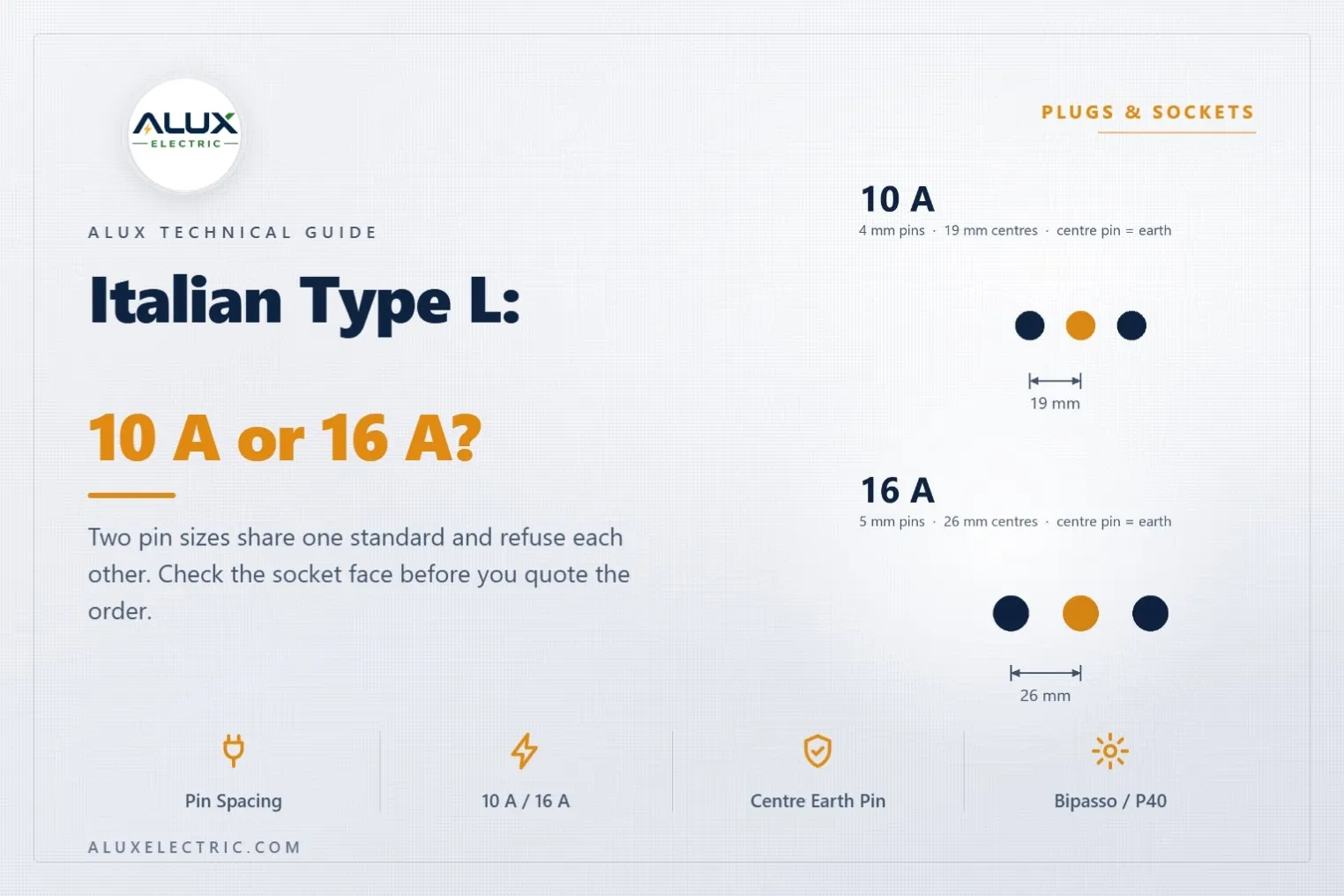
Type L looks like the simplest plug in Europe: three round pins in a straight line, no shutter, no collar. It is also the one that generates the most returns, because the same standard defines two sizes that will not enter each other's sockets. A distributor who orders 16 A plugs against a market that still runs 10 A sockets receives a container that fits nothing, and the mistake only surfaces at the customer's wall.
One standard, two plug sizes
The Italian plug and socket system is standardised as CEI 23-50, with roots in CEI 23-16 from 1965. Its geometry is unusual in Europe: instead of a triangular or rectangular pin pattern, the three pins sit in one horizontal line with the earth pin in the centre. The layout is symmetrical, so the plug goes in either way round, and the centre pin is what carries protective earth.
The split into two sizes is historical rather than technical. Until the second half of the twentieth century many parts of Italy had two separate supply contracts, one for lighting and one for other loads, often at different voltages. The small plug served lighting circuits and the large plug served power circuits, and both survived into the modern single-supply grid. That is why a country with one national standard has two incompatible plug families in daily use.
| Type L 10 A | Type L 16 A |
Pin diameter | 4 mm | 5 mm |
Centres between pins | 19 mm | 26 mm |
Maximum load at 230 V | about 2300 W | about 3680 W |
Typical duty | Lighting, chargers, small appliances | Ovens, washing machines, heaters |
Fits a 16 A socket | No | Yes, in a 16 A or bipasso socket |
The physical difference is only a few millimetres, which is exactly why it is missed on a purchase order. Four millimetre pins on 19 mm centres cannot be forced into a 16 A socket, and five millimetre pins on 26 mm centres cannot enter a 10 A socket. There is no partial fit and no workaround at the wall, which is better for safety than an adapter that half-connects, and worse for anyone who specified from a photo.
What each socket face accepts
When a buyer says the market uses Type L, the useful question is which socket face is on the wall. There are four you will meet in Italy, and they differ in what they accept.
Socket face | Accepts | Notes |
Type L 10 A only | 10 A Type L, thin Europlug (CEE 7/16) | Legacy lighting circuits, older apartments |
Type L 16 A only | 16 A Type L | Often rejects even a Europlug because of the wider spacing |
Bipasso (CEI 23-50 P17/11) | 10 A Type L, 16 A Type L, Europlug | Figure-eight openings; does not take a Schuko plug |
P40 (Italian-Schuko hybrid) | Type L 10 A and 16 A, Schuko CEE 7/4, hybrid CEE 7/7 | Recessed round cavity plus side earth contacts |
The bipasso face is the one most often misunderstood. It solves the 10 A versus 16 A problem, and it is what modern Italian installations use, but it is not a universal socket: a Schuko plug has thicker pins, a wider body and expects side earth contacts that a plain bipasso face does not have. Only the larger P40 face adds the recessed cavity and the side contacts that make Schuko and hybrid plugs fit. If your customer's appliance arrives with a moulded Schuko or hybrid plug, a bipasso socket will not rescue the installation.
Three mistakes that show up in distributor orders
First, ordering 16 A plugs for a market that is still largely 10 A. The 16 A plug is the right choice for appliances, but a retail pack aimed at replacement and DIY demand has to match what is already on the wall. Second, assuming a Europlug covers the 16 A gap. The thin two-pin Europlug is built for 19 mm spacing at 2.5 A; it fits 10 A and bipasso faces, not a 16 A-only socket. Third, treating Type L as interchangeable with Schuko because both are 230 V European systems. They are not, and the return rate on that assumption is close to total.
Adapters exist and are widely sold, but they only change geometry. An adapter does not convert voltage, and it can break the earth path if a three-pin plug is fed from a two-pin adapter. For a distributor, an adapter in the box is a workaround for a specification error, not a feature.
Voltage is the easy part
Every Italian socket delivers 230 V at 50 Hz, whatever the face looks like, so voltage is rarely the problem. The complication is mechanical and historical: the same country runs two pin sizes, four socket faces, and a stock of legacy 10 A installations that will not be rewired for decades. Italy also permits Schuko in new installations, which is why hybrid faces have become the default in renovated buildings.
Specifying the order
State four things and the order will be right. The socket face the product must mate with, not just the country. The current rating, 10 A or 16 A, tied to the appliance class it serves. The cable or assembly the plug will be moulded onto, since strain relief and body size follow from it. And the marking and packaging the market requires, because these are decided before production. Our ALX-0027 is the 16 A 250 V Type L plug, built for appliance wiring, replacement and OEM cable assembly, with private marking and packaging available for volume programmes. Final ratings and certification requirements are confirmed against the target market before production rather than assumed.
Next step
Send us the target market, the socket face your product has to mate with, and whether the appliance is a 10 A or 16 A load, and we will confirm the plug variant, the cable assembly and the marking in one reply. Samples can be reviewed before bulk production. Reach the team at /contact-us/ or message us on WhatsApp for a faster answer.