Oct 23, 2026News & Insights
3P+E or 3P+N+E: 200V vs 380V
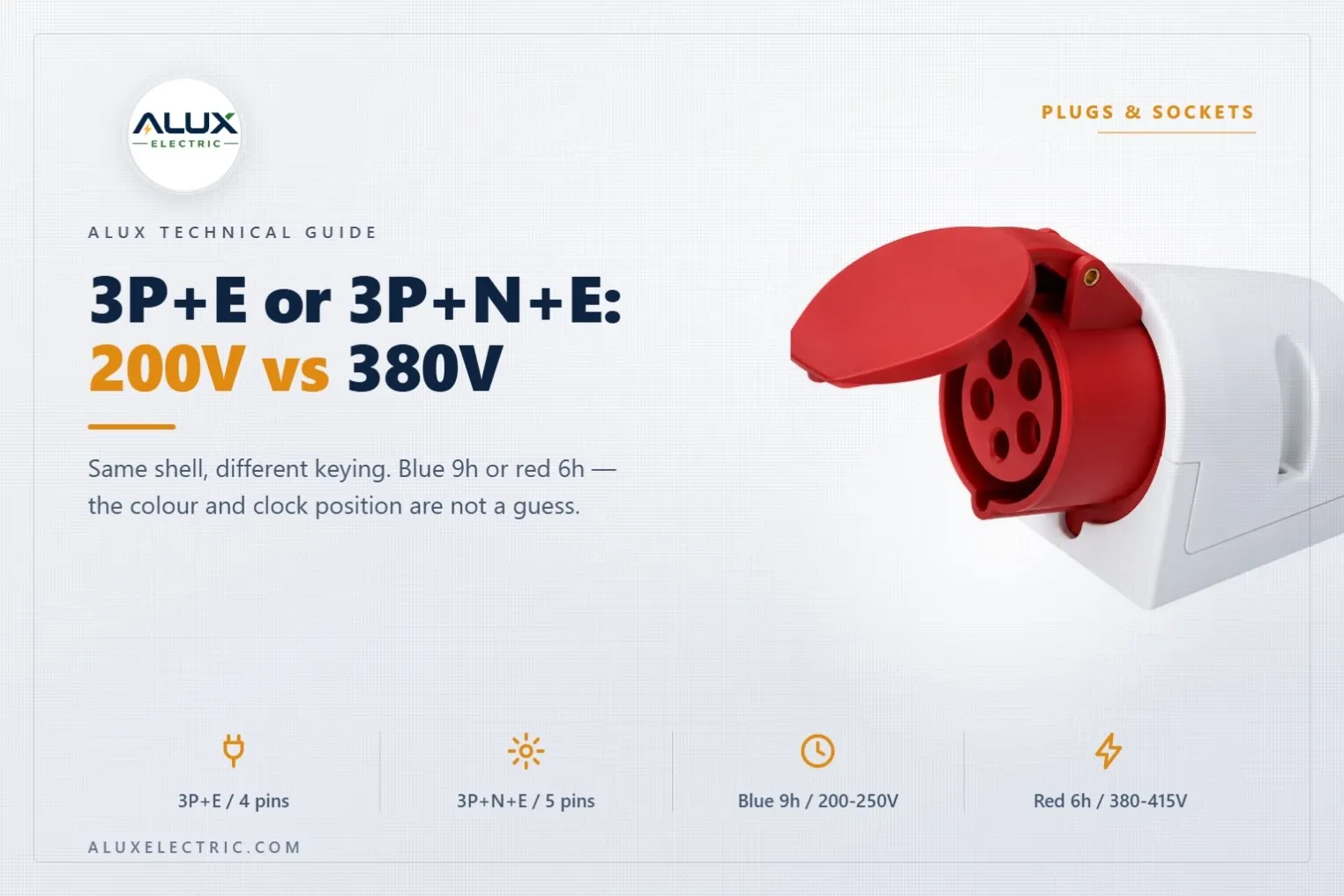
Same shell, different keying: 200-250 V three-phase is blue 9h, 380-415 V is red 6h. Pick the pole count and the plug mates first time.
A three-phase industrial plug that will not go into the socket is one of the most avoidable costs in a project. The unit is not defective and the rating is not wrong: the keying does not match. Under IEC 60309 the shape of the shell, the colour of the housing and the clock position of the earth contact are all tied to the voltage and the pole count, and they exist precisely so that a 200 V plug cannot be forced into a 380 V supply. This guide separates the two decisions buyers actually have to make - how many poles, and which voltage band - and gives the keying table to quote from.
Two independent decisions
The first decision is the pole count. 3P+E is four contacts - three phases plus earth, written 3P4W in some catalogues. 3P+N+E is five - three phases, neutral and earth, 4P5W. This is decided by the load, not by the supply: it depends on whether the equipment needs a neutral conductor at all.
The second decision is the nominal voltage band, and this is the one that sets the colour and the keying. A 4-pin connector is not 'a 380 V connector'; it is a 4-pin connector whose earth contact sits at 6h for 380-415 V and at 9h for 200-250 V. Both exist, both are common, and they will not mate with each other.
What the clock position locks
Look into the face of a socket. The earth contact sits at an angle measured like the hour hand of a clock, with the keyway at 6 o'clock as the reference. That position, together with the housing colour, is what makes a given voltage and frequency physically un-mateable with every other. The earth pin is also made with a larger diameter than the phase pins, so it cannot be pushed into a phase contact.
The following positions are from the earth-contact table of EN IEC 60309-2 (Table 210 in the 2023 edition; Table 104 in earlier editions) and agree across manufacturer reference tables and connector catalogues:
3P+E (4 pins) - voltage | Earth contact | Housing colour |
100-130 V, 50/60 Hz | 4h | Yellow |
200-250 V, 50/60 Hz | 9h | Blue |
380-415 V, 50/60 Hz | 6h | Red |
440-460 V, 60 Hz | 11h | Red |
480-500 V, 50/60 Hz | 7h | Black |
600-690 V, 50/60 Hz | 5h | Black |
3P+N+E (5 pins) - voltage | Earth contact | Housing colour |
57/100-75/130 V, 50/60 Hz | 4h | Yellow |
120/208-144/250 V, 50/60 Hz | 9h | Blue |
200/346-240/415 V, 50/60 Hz | 6h | Red |
250/440-265/460 V, 60 Hz | 11h | Red |
277/480-288/500 V, 50/60 Hz | 7h | Black |
347/600-400/690 V, 50/60 Hz | 5h | Black |
The 6h trap
Here is the mistake that catches experienced buyers. In three-phase connectors, 6h means 380-415 V and red. But in single-phase connectors - the 2P+E blue range - 6h means 200-250 V, and it is the 9h position that means 380-415 V. The same number reverses its meaning depending on how many poles the device has.
So 'give me a 6h' is not a specification. Neither is 'red 6h' on its own if the pole count is left implicit. Quote voltage, frequency, poles and current together, and the keying follows mechanically. Quote only the clock position and you are one assumption away from a container of connectors that will not mate.
3P+E or 3P+N+E: what the neutral is for
Choose 3P+E when the load is balanced three-phase and has no use for a phase-to-neutral voltage: three-phase motors, pumps, compressors, many welders and most pure machine drives. Four contacts, a smaller connector, less copper in the cable, and a lower unit cost. If nothing on the machine runs at 230 V, adding a neutral buys nothing.
Choose 3P+N+E when any part of the equipment needs a phase-to-neutral supply - control circuits, contactor coils, drives with electronics, integrated lighting, heaters, or a portable distribution box that will feed hand tools. This is why the red 5-pin 6h connector is the default across European construction sites: the same outlet delivers 400 V three-phase and 230 V single-phase, so one distribution network serves everything on site.
A 4-pin plug cannot be inserted into a 5-pin socket. The pin count differs, so the two are not interchangeable within the same voltage and current rating. Decide the pole count from the load first, and treat it as a separate line item from voltage.
Where 200 V and 380 V each apply
380-415 V at 50 Hz - the blue-and-red world's red 6h - is the standard three-phase supply across Europe, most of Asia, Africa, the Middle East and much of South America. It is the default assumption for exported machinery and for site distribution.
200-250 V three-phase - blue 9h - is what you specify where the local three-phase supply sits in that band: Japan's 200 V systems, and 208 V or 240 V three-phase in North American and some Latin American installations. In North America, Series II devices are generally used, which brings the 20 A, 30 A, 60 A and 100 A ratings alongside the 16 A, 32 A, 63 A and 125 A of Series I. Confirm which series your market expects before ordering, because the two are not interchangeable at the same nominal current.
Neither is scarce. The failure mode is not supply - it is a buyer in one market ordering the keying they know from another.
What to write into the enquiry
Question | Why it fixes the keying |
Nominal voltage and frequency? | Sets the colour and the earth-contact position |
Does the load need a neutral? | Decides 3P+E (4 pins) or 3P+N+E (5 pins) |
Current rating? | 16/32/63/125 A Series I, or 20/30/60/100 A Series II |
Which market is it shipping to? | Series I vs Series II, and the local voltage band |
Ingress protection required? | Rating applies to the mated pair, not the loose plug |
Plug, socket, or both? | A mating pair has to be specified as a pair |
Ask for the keying on the datasheet or marking plate of the exact part number, not on a range-level description. Ratings apply to a mated pair under test conditions - an uncapped plug is not protected at all.
The mistakes that turn into returns
Four come up repeatedly: specifying 6h from memory without stating the pole count; ordering 3P+E for a machine whose control panel needs 230 V, so the connector mates and half the machine has no supply; mixing Series I and Series II ratings; and treating the ingress code as a ladder when splash, jet and immersion are separate tests.
Next step
Send us the supply voltage and frequency, the pole count your load needs, the current rating and the destination market, and we will confirm the exact keying and part numbers before you commit to a range. If you are still unsure about pole count, ask whether any part of the equipment runs at phase-to-neutral voltage - that settles it.
Talk to our team on the contact page: /contact-us/ - or message us on WhatsApp for a faster reply.