News & Insights
Which RV Dogbone Adapter Do You Need?
TT-30, 14-50, L5-30 and L14-30 all say 30 or 50 amps but not the same voltage. Match the pedestal face first, then the pass-through rating.
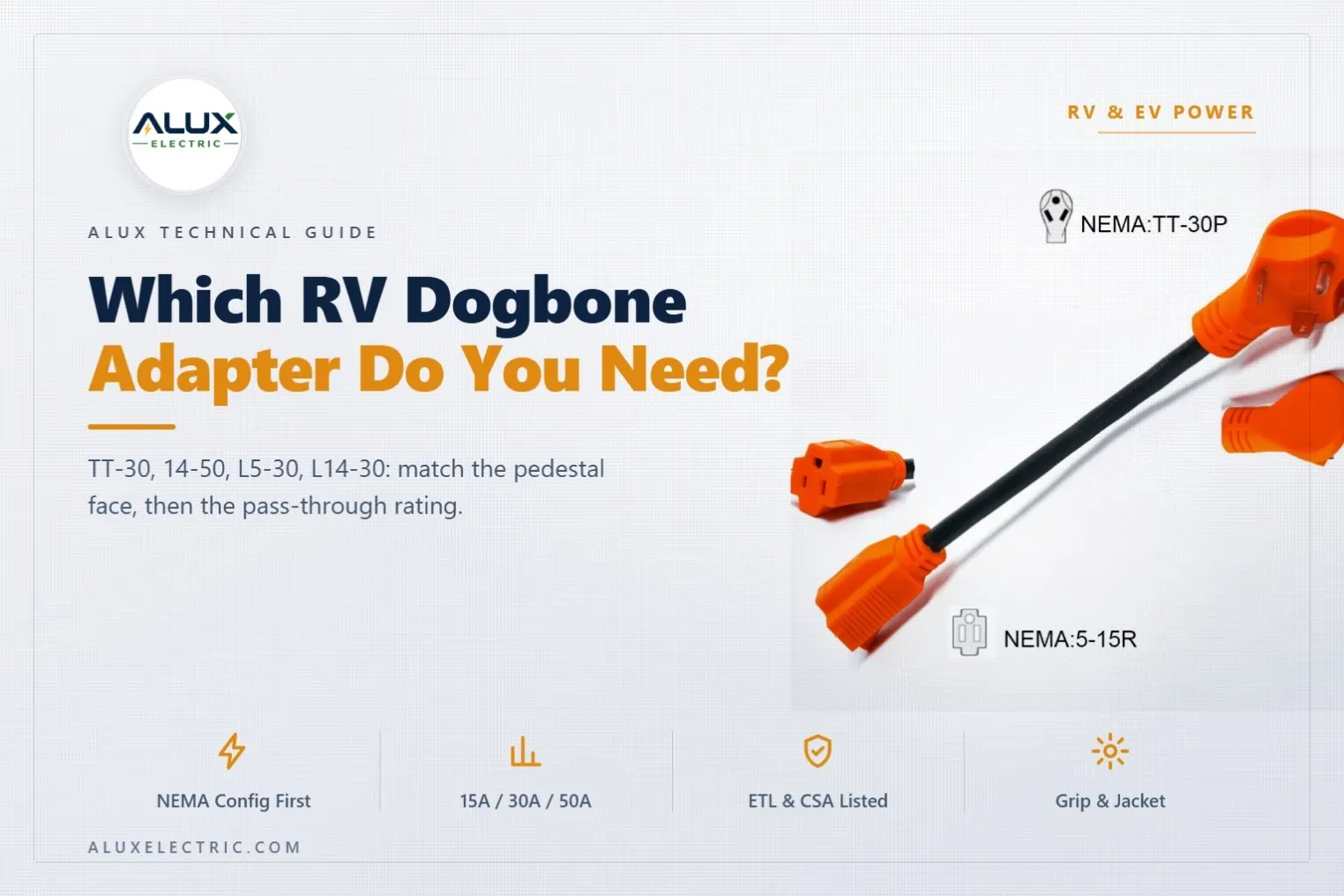
A dogbone adapter is the short moulded jumper that lets an RV plug into a pedestal outlet it was never built for. On a shelf they all look alike: black jacket, two heads, about a foot of cable. What separates a useful one from a returned one is the NEMA configuration stamped into each end, because that decides whether the rig sees 120 V, 120/240 V, or nothing at all. This is the sequence we walk distributors and fleet buyers through before they commit to a production order.
Read the pedestal face, not the amp number
In a NEMA designation the number before the dash is the configuration, and it tells you the voltage and the pole/wire count. The number after the dash is only the amp rating. That is why two outlets can both be called 30 amp and be completely different supplies: a TT-30R is 120 V with one hot, a neutral and a ground, while a 14-30R is 125/250 V with two hots between which you measure 240 V. Put a 120 V rig on the second one through the wrong adapter and you feed 240 V into a converter that was never rated for it.
NEMA config | Voltage | Amps | Poles / wires | Where you meet it |
TT-30R | 120 V | 30 A | 2-pole 3-wire | RV pedestal, 30 A rigs |
5-15R / 5-20R | 125 V | 15 / 20 A | 2-pole 3-wire | Household, generator duplex |
14-50R | 125/250 V | 50 A | 3-pole 4-wire | 50 A RV pedestal, ranges, EV |
L5-30R | 125 V | 30 A | 2-pole 3-wire locking | Generators, marine shore power |
L14-30R | 120/240 V | 30 A | 3-pole 4-wire locking | Generator transfer switches |
The suffix also matters: P is the plug (male) and R is the receptacle (female). An adapter is described plug-to-receptacle, so a TT-30P to 5-15R takes a 30 A pedestal down to a household outlet, and a 5-15P to TT-30R does the opposite. Getting those two mixed up in a purchase order is the single most common error we see from first-time buyers.
Stepping down: 30 A pedestal to a 15 A appliance
The highest-volume dogbone in a dealer parts bin is the TT-30P to 5-15R step-down. Our 30 A to 15 A version uses a NEMA TT-30P male and a NEMA 5-15R female, three-wire copper conductors, a one-foot jacket, and moulded finger grips on both heads so it can be pulled out by the body rather than by the cable. It is ETL Listed and CSA Approved for North America, and it is rated 125 V at 15 A maximum pass-through.
The point every buyer needs to hear: a dogbone adapter is not a circuit breaker. The pedestal's 30 A breaker protects the pedestal wiring, not the 15 A cord and not the appliance plugged into the far end. Keep the connected load at or below the pass-through rating, which for a 15 A end means roughly 1,800 W, and treat the adapter as a connector rather than as protection.
Stepping up: household outlet to a 30 A rig
The reverse adapter, typically 5-15P to TT-30R or 5-15P to L5-30R, gets a 30 A rig onto a household or generator outlet for driveway loading and storage-yard power. It works, but it creates no capacity. A 15 A outlet delivers about 1,800 W, and where a load runs for hours the circuit is planned at 125 percent of that load, so roughly 12 A of continuous draw is the realistic ceiling. One roof air conditioner plus the converter will usually trip it, and a customer who expects 30 A of service from a 15 A wall outlet is a customer who will blame the adapter.
30 A to 50 A: the two-leg difference
A 50 A rig is wired for a 14-50 supply: two hots, a neutral and a ground at 125/250 V, nominally 12,000 W across both legs. A 30 A rig on TT-30 sees one hot at 120 V and roughly 3,600 W. Adapters between the two are among the best-selling SKUs in the category, but they only ever deliver what the smaller side can supply, so a 50 A rig parked on a 30 A pedestal has to be loaded like a 30 A rig.
Pedestal | Rated supply | Realistic continuous load |
TT-30R, 30 A | 120 V x 30 A = 3,600 W | About 2,880 W |
14-50R, 50 A | 240 V x 50 A = 12,000 W | About 9,600 W |
Those continuous figures come from sizing the circuit at 125 percent of the load, which is the rule that turns a 30 A rating into 24 A of continuous draw and a 50 A rating into 40 A. Quoting both numbers to a buyer is what stops the callback.
Twist-lock: when the pedestal is L5-30 or L14-30
Generators and some marine pedestals use locking devices. The L prefix means the blades curve and the connector locks with a partial turn, which is why fleets and generator customers prefer them: vibration will not walk the plug out. L5-30 is 125 V, 30 A, two-pole three-wire. L14-30 is 120/240 V, 30 A, three-pole four-wire. If the outlet on a customer's generator is an L5-30R, a TT-30P dogbone will not fit, and the correct SKU is an L5-30P to TT-30R or an L5-30P to 14-50R variant.
Four checks before you stock or ship
First, the pedestal configuration, read off the face rather than the amp number. Second, the rig's inlet, because that is the end that never changes. Third, the adapter's pass-through rating, which is always set by its lowest-rated end and not by the bigger plug. Fourth, the listing mark: ETL or CSA for North American shipments. Then ask about the grip. Moulded finger grips on both heads are a small cost that decides whether the product comes back as a reorder or as a complaint, especially for customers plugging in with cold or wet hands.
Sizing the cord that feeds the adapter
An adapter is only as good as the cable behind it. If the run from the pedestal to the rig is long, the cord gauge matters more than the adapter: voltage drop over distance is what starves an air conditioner at the far end. Our gauge-by-load-and-length guide covers where 10/3 stops being optional and starts being the only answer.
Next step
Send us the pedestal configuration, the rig inlet, the target pass-through rating and the market you ship to, and we will confirm the NEMA pairing, jacket, listing and grip style before you commit to tooling or a production run. If you are building a private-label range, send the packaging artwork at the same time. Reach our team at /contact-us/ or message us on WhatsApp for a faster reply.