
Oct 26, 2026News & Insights
Retractable Extension Cord Reels: Buyer Guide
Buying retractable extension cord reels in volume? The specs, mount types and supplier checks that decide whether a reel program survives the field - gauge, length, rewind, packaging.
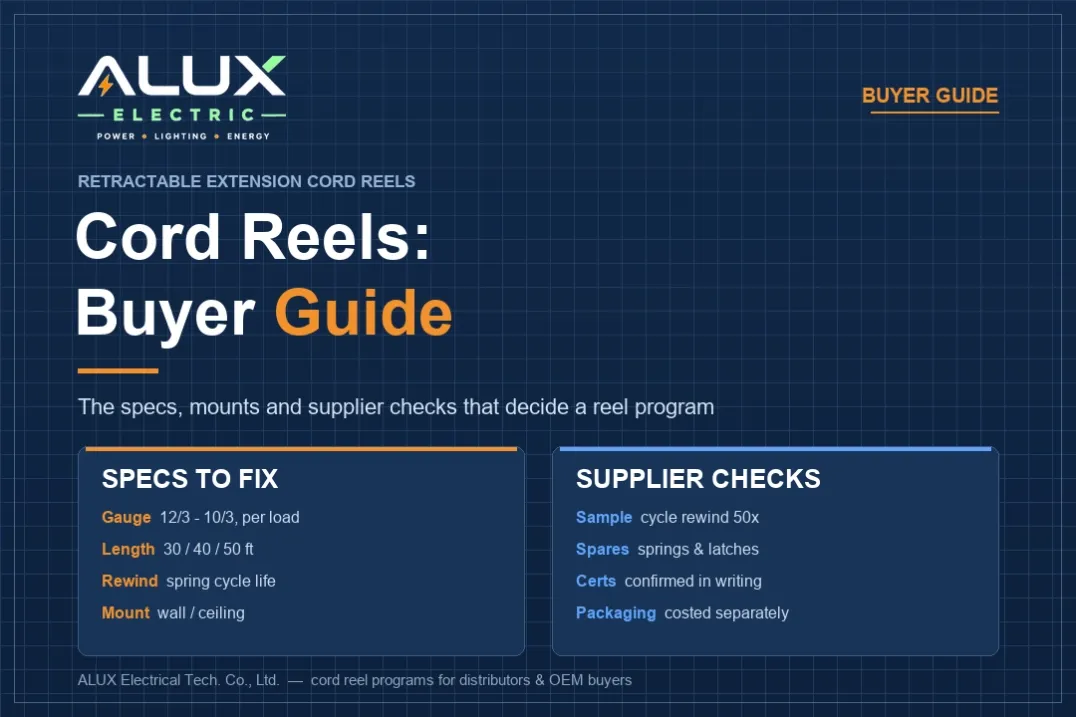
A retractable extension cord reel looks like a simple product - a spring, a cord, a case - but it is the piece of equipment in a workshop that gets touched every single day. Buy the wrong one and your returns rate tells you about it within a season: cords that do not retract, cases that crack, springs that lose tension.
This guide is written for distributors, retailers and OEM buyers building a cord reel program in volume. It walks through the specs to fix before you request a quote, the mount types and where each fits, and the supplier checks that separate a reel that lasts from a reel that gets returned.
The 8 Specs to Fix Before You Request a Quote
- Wire gauge and conductor count. 10/3 AWG carries substantially more current than 12/3 or 14/3 - match the gauge to the load your buyers will actually pull. A 10 AWG reel is a workshop product; a 14/3 reel is a household product. The price difference follows the copper.
- Cord length. 30 ft, 40 ft and 50 ft are the volume standards. Length drives both copper content and spring size - a 50 ft reel is not a 40 ft reel with more cord.
- Rating. Check the amperage/voltage rating printed by the factory and confirm it matches the gauge and plug configuration - the rating is a system property, not a label.
- Mount type. Wall/ceiling mount is the default for workshops; portable bench-top units exist but move less volume. Fixed-mount reels dominate B2B programs.
- Rewind mechanism. Spring-driven auto-rewind is the standard. Ask about the spring cycle life and whether the ratchet/latch is replaceable - the spring is the first thing that fails.
- Guide and stopper. A cord guide that routes the cord onto the drum evenly prevents pile-ups; an adjustable stopper lets the user lock out a working length.
- Plug and outlet configuration. Match your market: NEMA 5-15P for North America, Schuko for Europe. Multi-outlet heads change tooling and assembly cost.
- Case material and finish. Impact-resistant polymer housings with UV stabilizers hold up in garages and job sites; metal housings cost more and add weight.
Cord Reel Types at a Glance
Type | Mount | Typical length | Typical program |
Light-duty household reel | Wall / bench | 25-30 ft, 14/3 | Retail, entry price tier |
Heavy-duty workshop reel | Wall / ceiling | 40-50 ft, 12/3-10/3 | Distributor, workshop |
Industrial auto-rewind reel | Wall / ceiling | 50 ft with auto-rewind | Industrial MRO, fleet |
Multi-outlet reel | Wall | 2-way, 16 A 230 V | EU retail, garage |
(Ratings and configurations vary by factory - confirm the exact spec sheet per model during the RFQ.)
OEM and Private-Label Programs
Reels are a strong private-label category because the housing carries your brand visibly for the whole life of the product. The usual program structure:
- Your logo and color on the housing (mold or pad print - mold tooling is a one-time cost).
- Your packaging spec: color box, hang tag, barcode.
- MOQ quoted per SKU - mixed-model orders are often possible, but the per-SKU minimum shapes your assortment.
- Packaging is the line item that changes most between suppliers - cost it separately from day one.
(For how volume and packaging change unit cost across a cord program, see our extension cord price comparison guide.)
Supplier Checks Before You Commit
- Sample order first. Cycle the rewind 50 times out of the box. A spring that fades by cycle 30 is a returns-rate problem, not a sample problem.
- Ask what the spring cycle rating is and whether replacement springs or latches are available as spares.
- Certification requirements are confirmed in writing during the RFQ - listings are per cord type and per factory, so ask exactly which configurations a listing covers.
- Check the stopper and guide hardware - these are the small parts that generate the most warranty claims on cheap reels.
FAQ
Which gauge should a distributor start with?
12/3 is the volume workhorse for workshop programs; add 10/3 for the heavy-duty tier and 14/3 for household retail. Start narrow - one gauge, two lengths - and widen after the first sell-through.
What length sells most in volume?
40 ft and 50 ft dominate workshop and industrial programs; 25-30 ft fits household retail. Longer is not automatically better - spring tension and drum size must match the length.
Can reels be private-labeled?
Yes. Housing logo, housing color and packaging are all brandable. The mold/printing setup is a one-time cost; the per-unit packaging cost stays with every reorder.
Wall mount or portable?
Wall/ceiling mount is the B2B standard - it keeps the floor clear and the cord off the bench. Portable reels are a niche SKU, not a program foundation.
Get a Reel Program Quote
Send your target market, gauge, length, mount type and packaging requirements through our contact page - we quote per program with certification scope confirmed in writing during the RFQ.