Oct 13, 2026News & Insights
Extension Cord Price Comparison: Bulk Cost Guide
Comparing extension cord quotes? The 5 real cost drivers - copper, jacket material, length, certification, packaging - and how to compare bulk prices correctly.
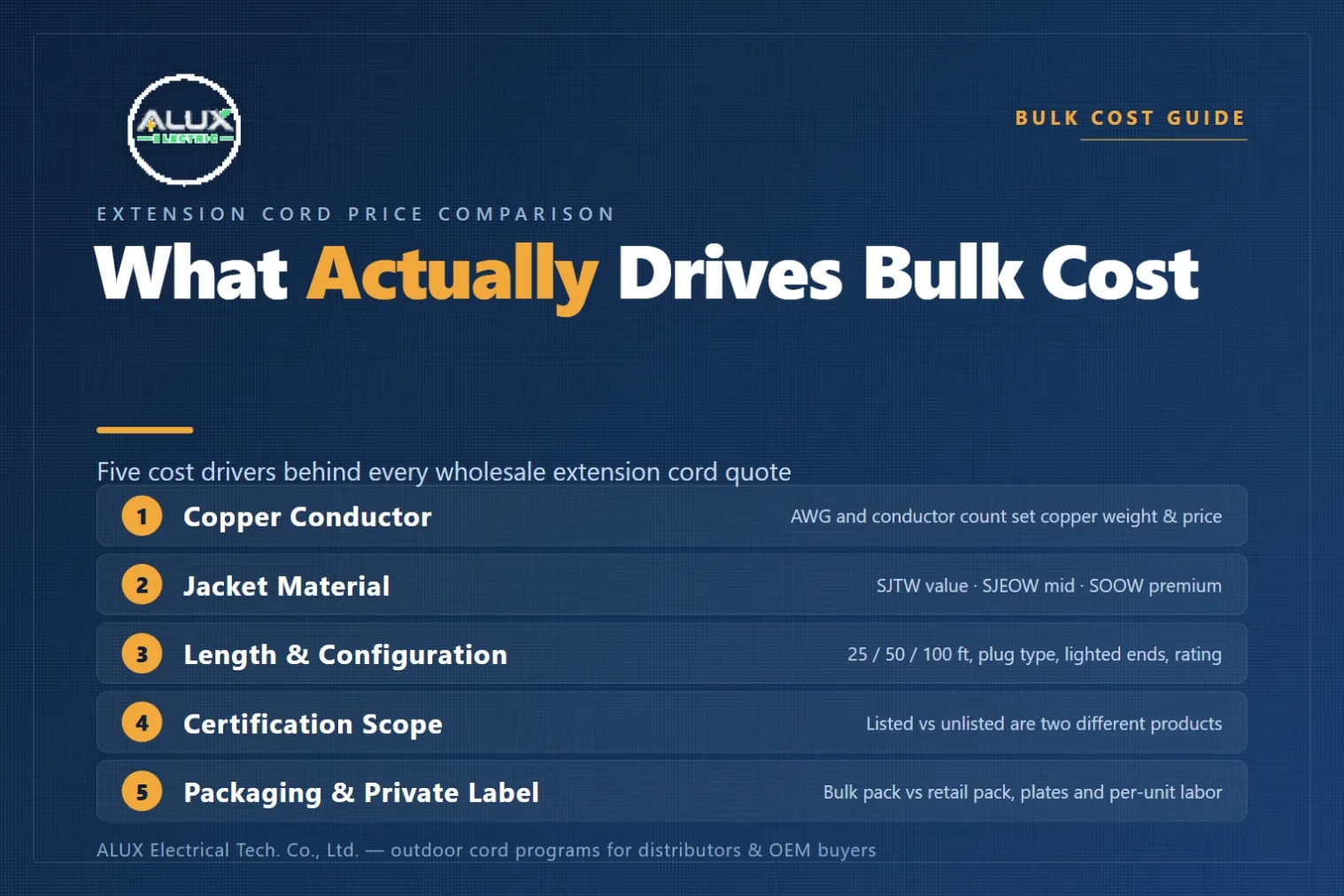
Two quotes for what looks like the same 50 ft 12/3 SJTW extension cord can sit far apart - and the cheaper one is not automatically the better deal. Bulk extension cord pricing comes down to five drivers: the copper conductor, the jacket material, the cord length and configuration, the certification scope, and the packaging. Once you compare quotes driver by driver instead of line by line, the differences explain themselves.
This guide is written for distributors, retailers and OEM buyers sourcing outdoor extension cords in volume. It explains what each driver does to the unit price, how the common jacket types (SJTW, SJEOW, SOOW) sit in cost tiers, and how to compare two quotes correctly before you commit.
The 5 Cost Drivers of an Extension Cord Quote
1. Copper conductor - the biggest single driver
The conductor is where most of the money goes. Extension cords are built with stranded copper, and the amount of copper in a cord is fixed by two numbers: the wire gauge (AWG) and the conductor count.
- 12/3 AWG means 12-gauge wire with 3 conductors. It carries more current, and uses substantially more copper than 14/3 or 16/3.
- Moving from 16/3 to 14/3 to 12/3 raises copper content at every step - and copper is priced by weight.
Because copper trades on commodity markets, its price moves. That is why serious suppliers put a validity window on quotations: a quote made this month may not hold next quarter if copper has moved. When you compare two quotes, check the date before you compare the numbers.
2. Jacket material: SJTW vs SJEOW vs SOOW
The jacket is the second driver, and it is also where the letter codes come in. The designation printed on the cord tells you exactly what the jacket is:
- SJTW - S = Service Cord, J = Junior Service (300 V), T = Thermoplastic jacket, W = Weather Resistant. A PVC-based jacket: affordable, durable enough for general outdoor use, and the most common choice for retail and distribution programs.
- SJEOW - same 300 V service cord class, but E = Thermoplastic Elastomer (TPE) jacket and O = Oil Resistant. Better cold-flex, better abrasion behavior, better oil resistance - and a higher material cost than PVC.
- SOOW - S = Service Cord with no J, which puts it in the 600 V class; O = oil-resistant insulation, O = oil-resistant jacket, W = Weather Resistant. A rubber (thermoset) jacket: the toughest and most flexible of the three, and the most expensive to compound and process.
The rule of thumb is simple: PVC (SJTW) is the value tier, TPE (SJEOW) is the mid tier, rubber (SOOW) is the premium tier. The right choice depends on the market you sell into, not on which one is "best" - a household retail program does not need to pay for an SOOW jacket, and an industrial jobsite program should not try to save money with a jacket that stiffens in the cold. (For a deeper look at the two most common tiers, see our guide "SJEOW vs SJTW: Is the Extra Cost Worth It?" on the posts page.)
3. Length, gauge and configuration
Length is straightforward: a 100 ft cord uses twice the copper and jacket of a 50 ft cord. Standard program lengths are 25 ft, 50 ft and 100 ft, and the unit price scales with material content.
Configuration adds smaller but real increments:
- Plug and receptacle type. A molded NEMA 5-15P grounded plug is the baseline for North American programs; different outlet configurations, multi-outlet ends and locking connectors each change the tooling and assembly cost.
- Lighted ends. A power-indicator receptacle adds components and assembly steps - a visible feature that retails well, but it is not free.
- Rating. A 15 A / 125 V (1875 W) cord and a 13 A / 125 V (1625 W) cord are built to different ratings, and the rating is tied to the conductor and plug choices above.
When two quotes differ, the configuration block is the first place to look for an accidental mismatch.
4. Certification scope
If your market requires a listing - for example UL or CSA for North American flexible cords - the cost of that certification is built into the unit price: initial testing, factory inspections, and follow-up surveillance all carry fees that are amortized into production.
Two practical consequences:
- A certified cord and a non-certified cord are not the same product, even if they look identical. Never compare their prices directly.
- Certification scope is per cord type and per factory. If a quote claims a listing, ask which cord types and ratings it actually covers. (Note: certification status for any specific product line is confirmed in writing during the RFQ process - we do not print marks on quotes we cannot support.)
5. Packaging and private label
The last driver is the one buyers most often forget to cost. A bulk-packed cord in a plain carton is the cheapest way to ship; a retail-ready program - color sleeve, hang tag, barcode, printed box - adds printing, materials and assembly labor per unit.
Private-label programs add one more layer: your brand, your artwork, your packaging specification. The printing plates and setup are one-time costs, but the per-unit packaging cost stays with every reorder. When you compare a bulk-pack quote against a retail-pack quote, you are comparing two different products again.
SJTW vs SJEOW vs SOOW: Cost Tiers at a Glance
Designation | Jacket | Voltage class | Key property | Cost tier | Typical program |
SJTW | PVC (thermoplastic) | 300 V | Weather resistant, value | Value | Household retail, general outdoor |
SJEOW | TPE (thermoplastic elastomer) | 300 V | Oil resistant, cold-flex | Mid | Industrial, cold climates, RV, frequent handling |
SOOW | Rubber (thermoset) | 600 V | Oil resistant insulation + jacket | Premium | Jobsites, industrial equipment, harsh environments |
(The letter codes are industry-standard designations printed on the cord jacket - read them off any sample.)
MOQ and Private-Label Programs: How Volume Changes the Price
Unit price moves with volume for a simple reason: fixed costs (tooling, setup, artwork, production line changeovers) are divided across the order quantity. A 500-piece order carries those costs on 500 units; a 5,000-piece order spreads them ten times thinner.
For distributors building a private-label line, the practical advice is:
1. Start with a narrow SKU matrix - one jacket type, two gauges, two or three lengths - and widen it after the first sell-through. Ask your supplier for a starter SKU matrix with the first RFQ.
2. Ask for the MOQ per SKU, not per order. Mixed-SKU orders are often possible, but the per-SKU minimum is what shapes your assortment.
3. Treat packaging as a separate line item in your cost model from day one - it is the part of a private-label quote that changes most between suppliers.
How to Compare Two Quotes Correctly
Before comparing numbers, confirm the two quotes describe the same product. Check, in order:
1. Same designation? (SJTW vs SJEOW vs SOOW)
2. Same gauge and conductor count? (12/3 vs 14/3 vs 16/3)
3. Same length?
4. Same plug and receptacle configuration? (NEMA type, lighted end, outlets)
5. Same rating? (e.g. 15 A / 125 V)
6. Same certification scope? (and ask which cord types it covers)
7. Same packaging? (bulk pack vs retail pack, private label vs plain)
8. Same trade terms? (EXW vs FOB vs delivered - freight changes the real cost)
If any line differs, normalize it first - then compare. A quote that survives all eight checks and is still meaningfully cheaper deserves a sample order and an inspection, not blind celebration.
Get a Bulk Quote
The fastest way to an accurate, comparable quote is to send complete requirements in one message:
- Target market
- Cord type and wire gauge (e.g. SJTW 12/3)
- Cord length
- Plug and receptacle configuration
- Certification requirements
- Estimated quantity
- OEM or private-label packaging requirements
Send your list through our contact page and we will come back with a spec-matched quotation - you can also browse current program products like the 25 ft 12/3 SJTW outdoor extension cord and the 14/3 SJTW 3-outlet cord to see how we document specifications.
FAQ
Why is SJEOW more expensive than SJTW?
SJEOW uses a TPE (thermoplastic elastomer) jacket instead of PVC and adds an oil-resistant rating, with better cold-flex and durability. The higher material cost is what you are paying for - the voltage class (300 V) is the same.
Is a thicker cord (lower AWG number) always worth paying for?
No. Match the gauge to the load and the length: 12/3 for heavier loads and longer runs, 14/3 or 16/3 for lighter duty. Oversizing adds copper cost with no benefit to the end user; undersizing is a safety problem.
Does certification affect the price?
Yes. Listings such as UL or CSA carry testing, inspection and surveillance costs that are amortized into the unit price. A certified cord and a non-certified cord are different products - never compare their prices directly.
What information do I need to get an accurate quote?
Target market, cord type and gauge, length, plug/receptacle configuration, certification requirements, quantity, and packaging requirements. Complete requirements get a spec-matched quote; incomplete ones get an estimate that will move.
How does private-label packaging affect unit cost?
It adds printing plates or setup (one-time) plus per-unit packaging materials and assembly labor. It also changes with your packaging specification, so treat it as a separate line item when comparing suppliers.