Oct 5, 2026News & Insights
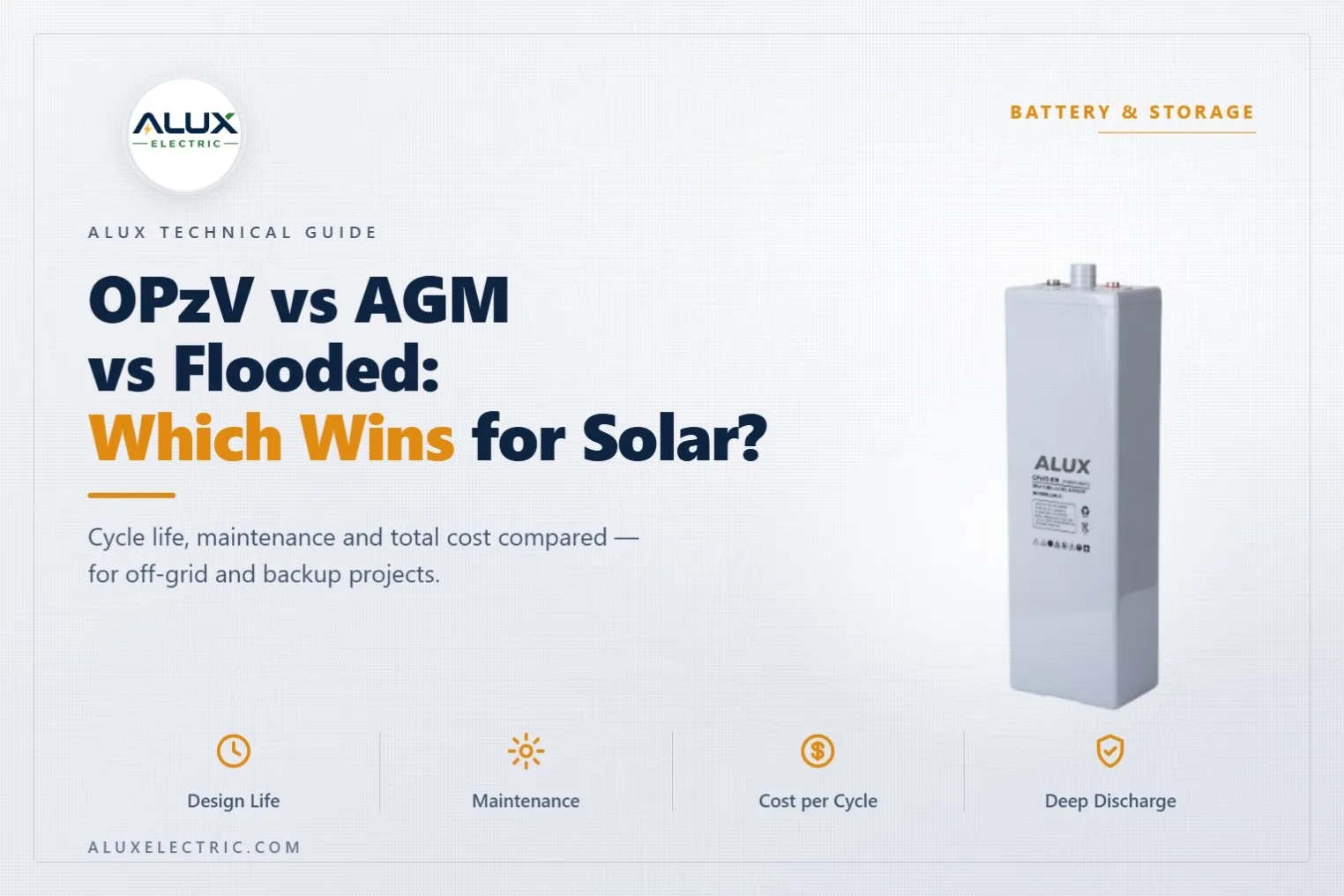
OPzV vs AGM vs Flooded: Solar Battery Selection
Compare OPzV, AGM and flooded lead-acid batteries for solar storage: depth of discharge, maintenance, heat tolerance and cost per cycle. Distributor guide.
OPzV vs AGM vs Flooded: Choosing the Right Solar Battery
Ask three suppliers which battery to stock for a solar project and you will get three answers. The honest one is: it depends on how deeply the battery is discharged, how hot the site gets, and whether anyone will be there to maintain it. Pick the wrong chemistry and the failure shows up 18 months later as a warranty claim, not as a spec sheet problem.
This guide compares the three lead-acid families distributors actually quote - OPzV tubular gel, AGM VRLA and vented flooded - and turns the choice into questions you can ask your customer before you send a price.
The three technologies in plain terms
OPzV (tubular gel): the positive plate is a tube that holds the active material in place, and the electrolyte is gelled rather than liquid. It is valve-regulated, so there is no routine topping-up, and the tubular construction resists the shedding that kills flat plates in deep daily cycling.
AGM (absorbed glass mat): the electrolyte is held in a glass mat separator. It is also valve-regulated and sealed, with low internal resistance, which is why AGM is common in standby and starting duties where big current is needed for a short time.
Flooded (vented): liquid electrolyte, removable vents, and a maintenance schedule. Tubular flooded types are the traditional workhorse for deep cycling where a technician can check electrolyte levels. Flat-plate flooded types are cheaper but far less tolerant of deep discharge.
Where each one fits
Application | Usually the better fit | Why |
Off-grid home, daily deep cycling | OPzV tubular gel | Tubular plates + gel handle repeated deep discharge and high ambient temperature |
Telecom / UPS standby, rare discharge | AGM VRLA | Low self-discharge, sealed, strong short-duration current |
Hot remote site, no maintenance visits | OPzV tubular gel | No topping-up, better resistance to heat and electrolyte stratification |
Budget project with a maintenance crew | Flooded tubular | Lowest cost per Ah and serviceable, but needs scheduled watering |
Engine start / high surge current | AGM | Low internal resistance delivers surge current |
What actually kills a solar battery
Chemistry matters, but field failures usually come from four things: sustained high temperature, discharging deeper than the bank was sized for, chronic undercharging because the controller profile does not match the battery, and leaving a bank partially charged for long periods. Any of these will shorten the life of all three types - it is just that some types tolerate the abuse better than others.
Cycle-life figures vary by model, depth of discharge, temperature and the test standard used. Rather than quoting a single number, ask the factory for the test report that matches the capacity and duty cycle you plan to sell, then put that same condition into your warranty terms.
What to specify before you quote
Daily depth of discharge and autonomy days: this drives the whole bank size, and it is the number most often guessed.
Highest and lowest ambient temperature at the site: charging voltage needs temperature compensation, and heat accelerates ageing.
Charge controller and inverter profile: confirm the absorption and float voltages can be set to the battery manufacturer's recommendation for the temperature range.
Transport and documentation: sealed VRLA types simplify shipping and handling rules compared with vented cells; confirm what paperwork your market requires before the order ships.
Terminal type, tray or rack dimensions, and whether the installation is indoors or in an unventilated enclosure.
How distributors should stock it
Most distributors do best with a narrow but deep range: one tubular gel capacity for solar projects, one AGM range for standby and starting, and - if a service team exists in the market - one flooded tubular line for price-led tenders. Fewer SKUs mean better forecasting, and the specification conversation stays consistent across your sales team.
For private-label programmes, agree early on the label artwork, the rating printed on the case, the warranty wording and the test documentation that ships with the pallet. Those four items cause more delays than tooling ever does.
Where to go next
If your customers are building solar storage banks, start with our tubular OPzV range - see the ALUX 2V OPzV solar battery page for the capacities currently in production. Send us your target capacity, autonomy requirement, annual volume and private-label needs, and we will come back with a matched specification and a quote.
Talk to our team on the contact page: /contact-us/ - or message us directly on WhatsApp for a faster reply.