News & Insights
L5-30P to 14-50R: Why Only 30A?
A 50 A receptacle fed from a 30 A twist-lock plug still tops out at 3750 W, 125 V. Which loads run, which never will, and what to confirm before ordering.
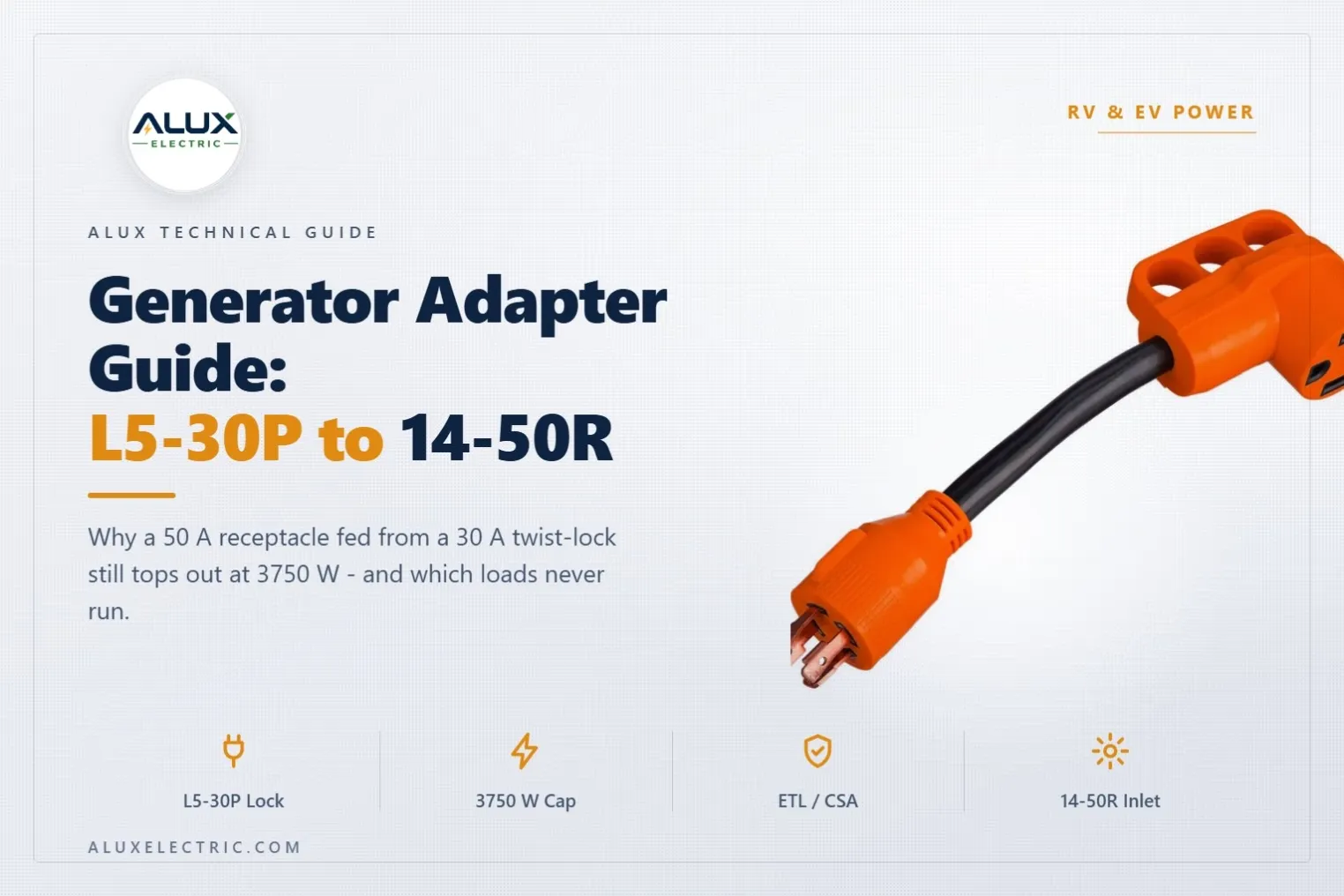
The scene repeats every season: a buyer with a 50-amp RV shore cord on one side and a generator with a single 30-amp twist-lock outlet on the other. An L5-30P to 14-50R adapter makes the two connect - and because the female end is a 50 A receptacle, it looks like a power upgrade. It is not. The adapter changes the plug shape, nothing else, and the number that governs the whole hookup is still the 30 A rating of the source. What that means for the loads, the wiring and the order is the subject of this article.
Two connectors, two different jobs
NEMA L5-30P is a 30 A, 125 V, 2-pole 3-wire grounding twist-lock plug, defined in the NEMA WD-6 configuration charts. Inside it are three conductors: one hot (terminal X), one neutral (W) and an equipment ground (G). The locking collar stops the plug walking out of the generator socket when the set vibrates - which is exactly why generator builders like it.
NEMA 14-50R is a different animal: a 50 A, 125/250 V, 3-pole 4-wire straight-blade receptacle with two hots (X and Y), a neutral (W) and ground (G). This is the outlet you meet at RV park pedestals, on generator panels and at EV charging stations. Four wires means it can feed two 120 V legs or one 240 V circuit - when both hots are actually energised.
| L5-30P (generator end) | 14-50R (RV end) |
Rating | 30 A, 125 V | 50 A, 125/250 V |
Configuration | 2-pole, 3-wire grounding | 3-pole, 4-wire grounding |
Blade type | Twist-lock, curved blades | Straight blade, 4 slots |
Conductors | 1 hot, 1 neutral, 1 ground | 2 hots, 1 neutral, 1 ground |
Where you meet it | Portable generator output | Park pedestal, RV inlet, EV charger |
What the adapter carries, and what it cannot
The L5-30P source has one hot, one neutral and one ground. Feed that into a 14-50R and only one of the receptacle's two hot slots has a live phase behind it. Most adapters bridge the same 120 V leg onto both X and Y so that a 50 A RV - whose loads are split across two legs - sees voltage everywhere on its 120 V panel. That wiring choice differs between brands, so confirm it with the supplier in writing rather than assuming it.
What never appears is a second phase. There is no 240 V across X and Y because there is only one hot at the source, so every 240 V load on the rig - a dual-element water heater, a large air conditioner wired for 240 V, a leveler or slide-out motor on a 240 V circuit - stays dead. This is not a defect of the adapter; it is arithmetic. One hot wire cannot become two phases, and an adapter that did fake it by bonding hots to neutral would be dangerous, not clever.
The ceiling stays at 30 A
The 50 A figure on the receptacle is a rating of the connector, not a promise of power. The supply is the generator, its outlet is protected at 30 A, and the whole hookup tops out at 30 A x 125 V = 3750 W. That is the arithmetic behind the 3750 W marking you will see on adapter listings across the market, ours included.
Load management is therefore the user's job. A rooftop air conditioner draws a hard inrush at start-up, a microwave and a kettle stack on top of it, and the generator breaker trips - not because the adapter failed, but because 3750 W was already spoken for. Distributors who explain this at the counter turn a warranty-return story into a satisfied customer; the adapter did exactly what it was built to do.
Reading the listing before you order
Adapter cords in this category are short - a foot or so of heavy copper between two moulded connectors - and the build quality lives in details a photo will not show. On market listings, 10 AWG copper conductors under an STW-style weatherproof jacket is the common specification for 30 A service, but do not take any listing's gauge on faith: ask the supplier to state the conductor gauge and jacket type in writing, and match it to the duty cycle the RV owner expects.
Our L5-30P to 14-50R dogbone is built with a 4-wire heavy-duty copper conductor and ships as an ETL-listed, CSA-approved assembly - both marks are stated on the product page. The thick rubber-style jacket and the grip-moulded connector bodies are there for campground handling: wet hands, sun, and being trodden on by the neighbour's dog. If a customer needs an LED power indicator, a longer lead or a different plug combination, that is a quotation conversation, not a catalogue assumption.
Questions that belong in the enquiry
Question | What it fixes |
Which outlet does the generator carry? | L5-30 vs L14-30 vs TT-30 - three 30 A sources that are not interchangeable |
Which inlet does the RV carry? | 14-50 vs SS2-50 twist-lock - the female end must match the shore cord plug |
What is the appliance list? | Confirms the 3750 W budget and which loads must be sequenced |
Are both hot slots fed, or only one? | Determines whether all 120 V circuits on the RV panel work |
Conductor gauge and jacket type? | Heat rise under sustained load; ask for it in writing |
Which listing documents apply? | ETL / CSA marks checked against the shipment, not the brochure |
The first two questions matter more than the rest combined, because the 30 A generator world has three common outlets and the 50 A RV world has two common inlets. An adapter is a one-way part: it converts exactly one plug into exactly one receptacle. Get either end wrong and the part returns.
Next step
Send us the generator's outlet configuration, the RV's inlet type and the appliance list, and we will confirm the adapter, the wiring choice and the conductor gauge in one reply. If the catalogue combination does not fit the job, tell us what does - mixed configurations are a production question, not a problem. Reach the team at /contact-us/ or message us on WhatsApp for a faster answer.