News & Insights
IP65, IP66 or IP67: Which LED Light?
IP65, IP66 and IP67 are three separate tests, not a ladder. Match the digit to rain, washdown or standing water - and check the gland, not just the label.
A tender for outdoor lighting usually states an IP number and moves on. The number gets copied into quotations, compared between suppliers, and occasionally used as the only technical filter in a bid. That is where projects go wrong, because IP65, IP66 and IP67 are not three steps on one scale. They are two digits doing two different jobs, and the water digit measures three different tests. Understanding which test your site actually imposes is worth more than one digit of bravado on a spec sheet.
Two digits, two separate tests
The IP code is defined in IEC 60529. The first digit covers solids: 5 means dust protected, where a limited amount of dust may enter but never enough to interfere with operation, and 6 means dust tight, verified under vacuum with fine dust and no ingress at all. For a luminaire near a cement plant, a grain store or a coastal road, that single step from 5 to 6 is the difference between a lens that hazes over in two years and one that stays clear.
The second digit covers water, and this is where the ladder logic breaks down. X5 is a jet from a 6.3 mm nozzle at 12.5 litres per minute; X6 is a powerful jet from a 12.5 mm nozzle at 100 litres per minute, roughly eight times the volume, from about three metres. X7 is not a stronger jet - it is a different test entirely: immersion for 30 minutes with at least 150 mm of water above the top of the fixture and a one-metre head at its lowest point. A fixture sealed for immersion and a fixture sealed against a pressure washer are engineered differently, and one does not automatically satisfy the other.
Rating | Dust digit | Water test | Where it belongs |
IP65 | Dust tight (6) | Jet, 6.3 mm nozzle, 12.5 L/min | Fully exposed outdoor fixtures: wall packs, area lights, pole-mounted floods |
IP66 | Dust tight (6) | Powerful jet, 12.5 mm nozzle, 100 L/min | Wind-driven rain, coastal exposure, pressure-washed facades and canopies |
IP67 | Dust tight (6) | Immersion, 30 min, 1 m head | In-grade and low-level fixtures where water pools, flood-prone underpasses |
Why IP67 is not simply one better
A number can be higher and still be the wrong protection. Immersion testing says nothing about a horizontal jet aimed at a gasket line at close range, and jet testing says nothing about a fixture sitting in standing water for half an hour. Plenty of well-built fixtures carry both marks because their designers tested both. A quotation that offers IP67 alone for a washdown wall is not necessarily stronger than IP66 - it is answering a question the site did not ask.
The reverse is more common and more expensive: IP65 specified for a coastal installation where wind drives rain horizontally for hours, or IP66 specified for an in-grade uplight that sits in a puddle after every storm. Both numbers are honest. Neither is a match.
The weakest point is rarely the housing
For luminaires, the IP test is run on the assembled fixture in its normal mounting position, cable entry included. That detail decides most field failures. An unsealed cable gland or a gland tightened onto the wrong cable diameter turns an IP66 housing into a funnel; a gasket compressed once too often by a maintenance crew stops sealing on the second closing; and a fixture that breathes through a Gore-type vent manages condensation that a fully sealed one condenses on the inside of the lens.
So the useful question is not only what the housing is rated, but how the water is kept out of the places it can enter: gland type and torque, gasket material, mounting angle that lets water run off rather than stand on a joint. These are the items to put in writing, because they survive long after the IP label has faded in the sun.
Housing material sets the baseline for all of this. A die-cast aluminium body with a machined gasket groove holds a seal far more predictably than a thin moulded housing whose screw bosses deform under torque, and the difference only shows up in year three when a lens starts fogging from the inside. That is also why two fixtures carrying the same IP66 label can behave completely differently on the same pole.
Matching the digit to the site
For fully exposed outdoor lighting, IP65 is the working baseline. Step up to IP66 where rain arrives horizontally, where the fixture will be pressure washed, or where salt spray and storm exposure come together. Reserve IP67 for fixtures at or near ground level, low points that collect water, and installations that can flood - and do not pay for it on a sheltered canopy where IP65 would run for a decade.
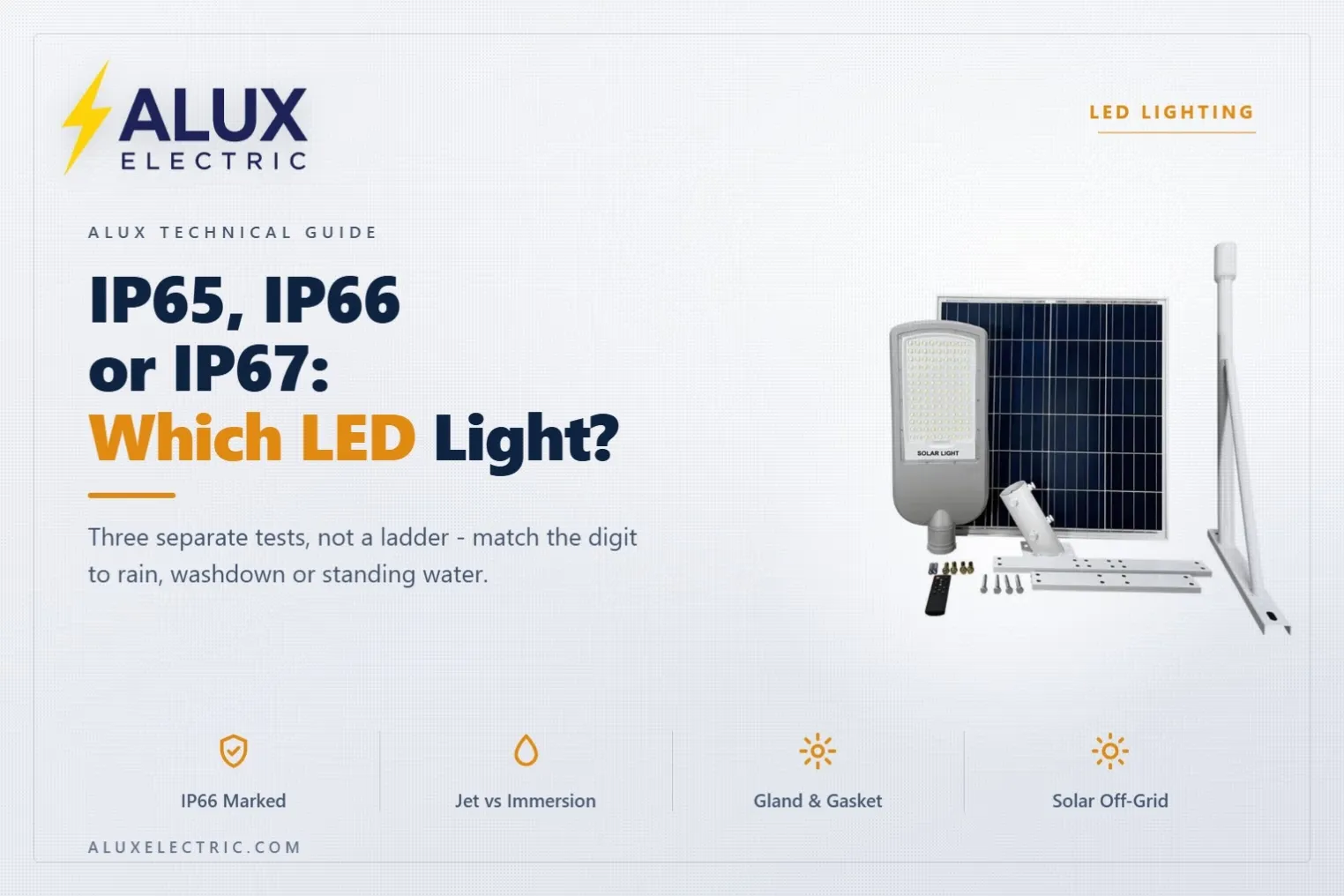
Our IP66 aluminium solar street light, ALX-0048, is listed as IP66 on its product page, and the rating is stated as a confirmed listing detail rather than a marketing claim. If your tender requires the test report behind that mark - and on public projects it often does - ask us for it in writing before the order, not after the inspection.
How to write it into the purchase order
Item | Why it matters |
Which digit, not just which number | IP66 and IP67 test different things; state the exposure, not only the code |
Test standard cited | IEC 60529 for the code, IEC 60598-1 for the luminaire safety context |
Mounting position and cable entry | The rating is tested on the assembled fixture as installed |
Gland type and cable diameter range | The most common real-world leak path |
Test report availability | Ask before the order; a label is not a report |
Spare gaskets and lens parts | A rated fixture loses its rating with the wrong replacement part |
Next step
Tell us the installation type - pole-mounted street light, canopy, in-grade uplight, floodlight - and the exposure it will face, and we will come back with the rating that fits plus the gland and mounting details that keep it true. If the project needs test documentation, say so in the first email and we will send it with the quotation. Reach the team at /contact-us/ or message us on WhatsApp for a faster answer.