
News & Insights
Retractable Cord Reel or Hand-Wound?
A coiled drum traps heat, so a 10 AWG reel is not a 10 AWG run. Match reel type, duty cycle and breaker rating before you commit a programme.
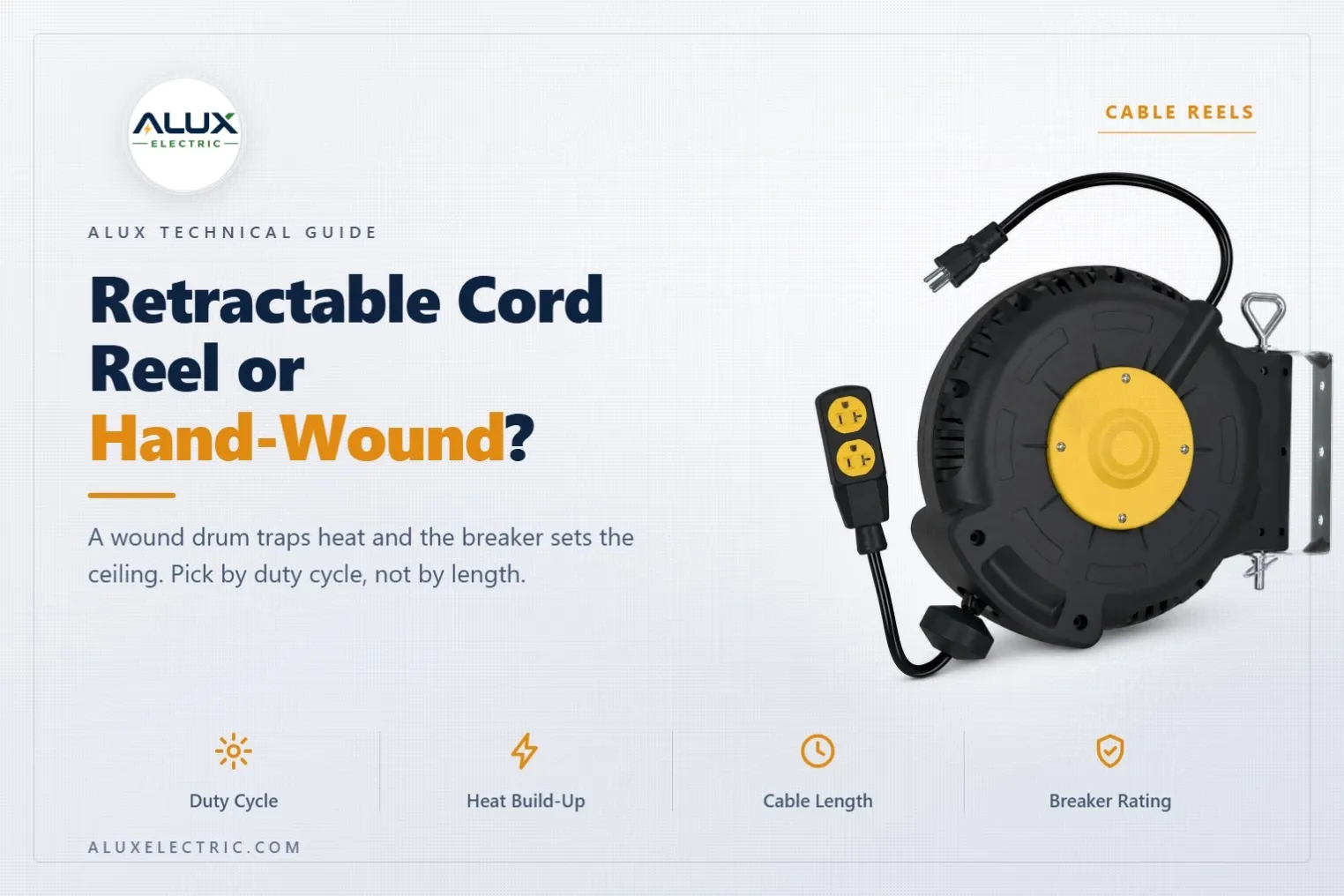
Cord reels look like a commodity until you are the one who has to spec a container of them. The housing, the drum and the outlet face are the easy parts. What actually separates one SKU from another is how the cable is paid out and rewound, because that decision decides the heat the cable can shed, the way the reel mounts, and the kind of customer who will buy it twice. This is the comparison we walk distribution buyers through before they split a reel programme into auto-retractable and hand-wound lines.
What auto-retract actually changes
An auto-retractable reel stores its energy in a spring motor. You pull the cable out to the length you need, the ratchet holds it there, and when you release it the drum rewinds the cable by itself. That changes the daily experience of the tool: no coiling, no kinks, no cable left on the floor to be run over. Our 40 ft 10 AWG auto-retractable reel is built for exactly that duty - workshops, garages and service bays where the cord is pulled out and put away dozens of times a day - with a triple-tap outlet at the head, a 20 A circuit breaker, and a bracket for wall or ceiling mounting so the reel sits above the work instead of in it.
A hand-wound reel gives up the spring motor and the ratchet. The user pays out the cable and winds it back by hand, or simply leaves it extended. What you gain is simplicity: fewer moving parts, a lower unit cost, and a lighter product that suits retail shelves, garages and maintenance crews who use the reel a few times a week rather than fifty times a day.
The heat problem no spec sheet prints
Here is the part that catches out first-time buyers. A flexible cord is rated with the cable laid out in open air, because that is the only way the copper can shed the heat it generates. Wind the same cable onto a drum and leave it there while current flows, and the inner turns are wrapped in layer after layer of their own warm neighbours. The heat that used to escape has nowhere to go. It is the same physics that makes electrical codes derate bundled conductors, and it is why every reel manufacturer prints the same instruction on the drum: fully unwind the cable before you put a real load on it.
This matters more on a retractable reel than anywhere else, precisely because the rewind is so convenient. The temptation is to plug in, pull out six feet, and leave the remaining thirty-four feet wound on the drum under full load. The current flowing through the coiled section is the same as the current flowing through the paid-out section, but only the paid-out section can cool itself.
Condition | What sets the limit | Practical ceiling |
10 AWG cord, fully extended | Flexible-cord ampacity table, NEC Article 400 | 30 A (two current-carrying conductors), 25 A (three) |
Our 40 ft 10 AWG reel, as built | The 20 A circuit breaker on the reel | 20 A, whatever the cord could carry |
Any reel, cable left wound under load | No published rating covers it | Unwind fully before loading |
Read that middle row again, because it is the line most buyers miss. On our reel the breaker, not the conductor, sets the ceiling at 20 A. Specifying a reel by its cord gauge alone tells you what the cable could do, not what the product will allow. The breaker is a feature, not a footnote: it protects the drum section of the cable from the customer who ignores the unwind instruction.
Duty cycle decides the type
The choice between the two families is really a choice about frequency of use. An auto-retractable reel earns its cost when the cable is handled constantly: production lines, inspection stations, service vans, assembly benches. It also earns its place anywhere the cable must not stay on the floor, which is why ceiling-mounted reels are standard over vehicle bays and machine pits. A circuit that runs three hours or more without interruption is a continuous load, and sizing practice plans that at 125 percent of the load - which is the same arithmetic that turns a 20 A breaker into a realistic continuous draw of about 16 A.
A hand-wound reel fits the opposite profile. Garage and workshop users in European retail markets, maintenance crews with a fixed bench, and event or seasonal power runs all fit it well. The buyer handles the cable occasionally, the lower price moves the SKU, and there is no spring mechanism to service. For those programmes the product question is jacket type and socket count rather than rewind duty.
| Auto-retractable | Hand-wound |
Pay-out and rewind | Ratchet lock, spring rewind | Manual, cable stays out |
Typical duty | Dozens of cycles per day | Occasional use |
Mounting | Wall or ceiling bracket | Wall bracket or free-standing |
Best-fit buyers | Workshops, service fleets, factories | Retail, garages, maintenance crews |
Cost driver | Spring motor and breaker | Cable length and socket count |
Four checks before you commit a programme
First, cable spec: gauge, length and jacket, chosen from the load and the run, not from what looks right on a shelf. Second, the protection: ask what breaker is fitted and at what rating, because that is the number your customer will experience. Third, the market: a reel headed for European retail needs the socket system of that market, which is a different SKU from a North American triple-tap workshop reel. Fourth, the duty: be honest about how many times a day the cable moves, because that is what decides whether the spring motor is a feature or a cost you did not need.
Sizing the cable that goes on the drum
If the reel is a component in a longer power chain, the cable spec carries the whole decision. Our guide to cord gauge by load and length covers where 10 AWG stops being an upgrade and starts being the minimum, and our jacket comparison explains what the letter codes on the sheath actually buy you in oil, water and abrasion resistance.
Next step
Send us the destination market, the daily duty you expect, and the cable spec you want on the drum, and we will quote the reel programme against it - auto-retractable and hand-wound side by side, with private-label housing colour, packaging and marking available for volume orders. Reach our team at /contact-us/ or message us on WhatsApp for a faster reply.