
Oct 18, 2026News & Insights
SJEOW vs SJTW: Is the Extra Cost Worth It?
SJEOW costs more than SJTW: oil-resistant jacket, finer stranding, better cold flex. See which cord your market actually requires before paying the premium.
Introduction
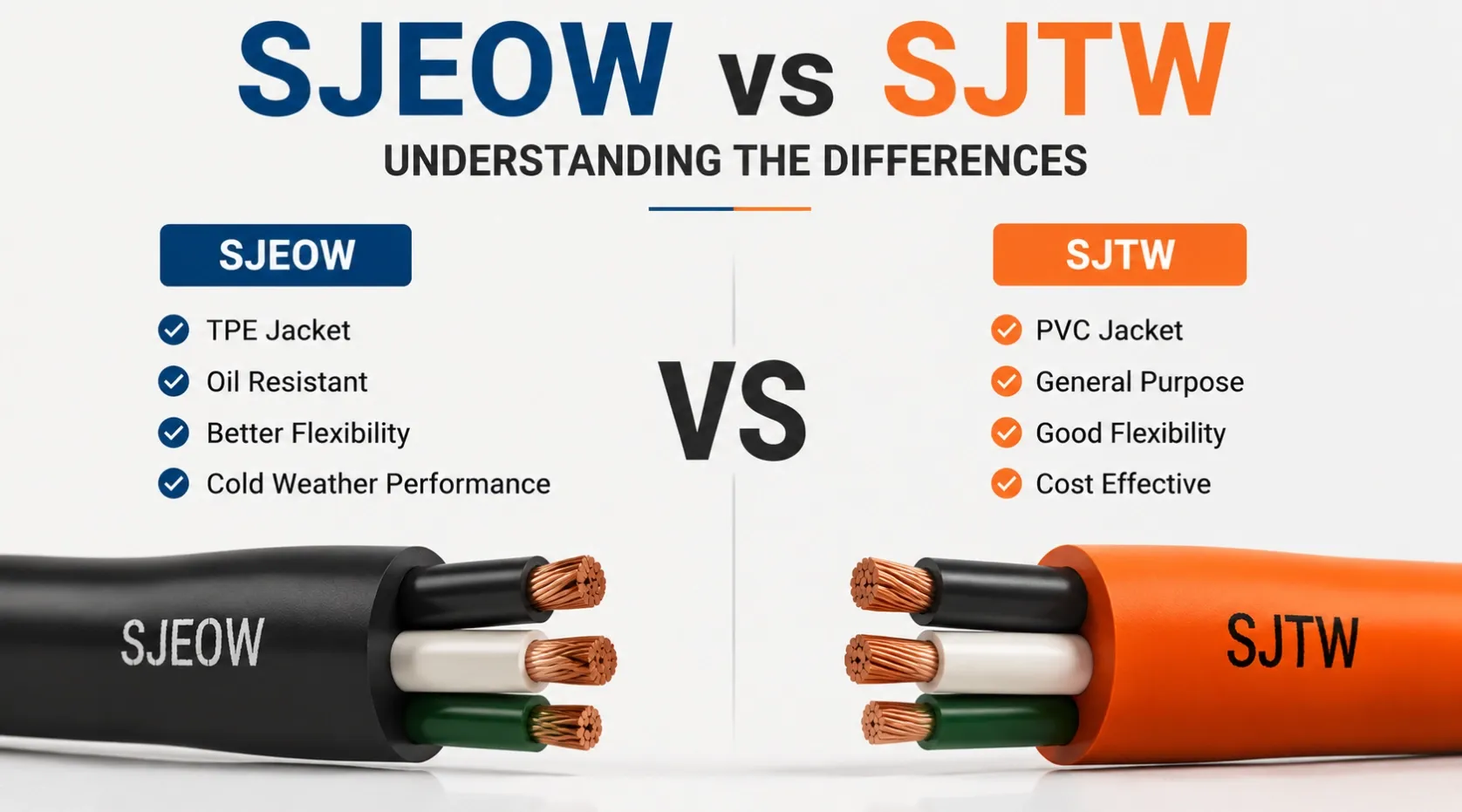
SJEOW cable is more expensive than SJTW because it uses a higher-performance thermoplastic elastomer (TPE) jacket, providing better flexibility, oil resistance, durability and low-temperature performance.
Although both SJEOW and SJTW are commonly used for extension cords and portable power applications, they are designed for different working environments.
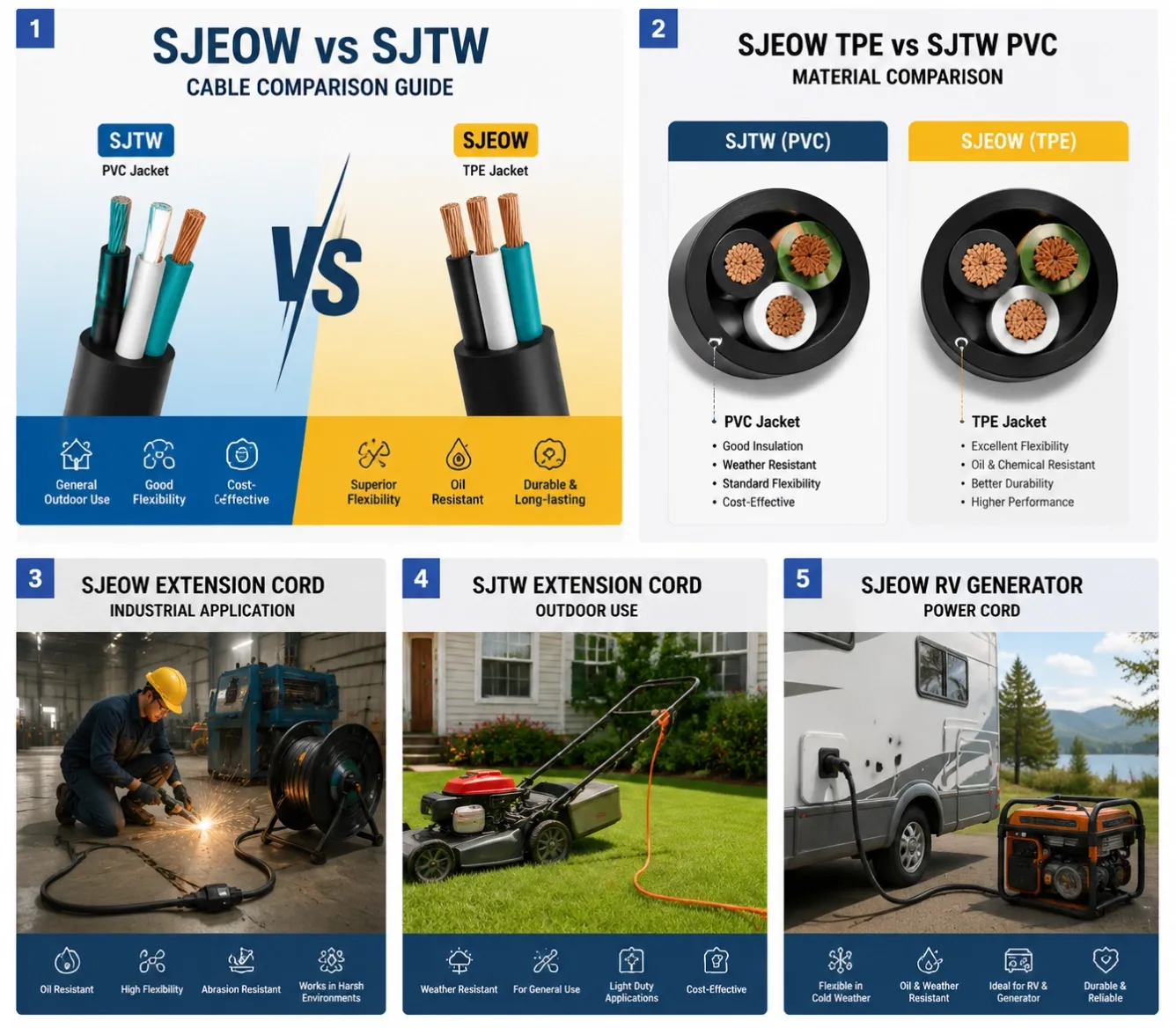
SJTW is a cost-effective solution for general outdoor use, while SJEOW is designed for more demanding applications such as industrial equipment, RV power cords, generators and frequently moved extension cables.
This article explains the differences between SJEOW and SJTW cables and helps you choose the right cable for your application.
For distributors and OEM buyers: Choosing SJTW or SJEOW is only one part of the specification. Wire gauge, cable length, plug configuration, certification requirements and target market should also be considered.
What Is SJTW Cable?
SJTW Cable Definition
SJTW is one of the most common types of portable power cords used in North America.
The letters represent:
Letter | Meaning |
|---|---|
S | Service Cord |
J | Junior Service (300V) |
T | Thermoplastic Jacket |
W | Weather Resistant |
SJTW cables usually use PVC-based insulation and jackets, making them affordable and suitable for general-purpose extension cords.
Common Applications of SJTW Cable
SJTW extension cords are commonly used for:
- Household extension cords
- Garden equipment
- Outdoor lighting
- Light-duty tools
- Temporary outdoor power
SJTW is a good choice when:
- The cable is not frequently moved;
- The environment is not extremely harsh;
- Cost efficiency is important.
What Is SJEOW Cable?
SJEOW Cable Definition
SJEOW is a higher-performance portable power cable designed for demanding applications.
The letters represent:
Letter | Meaning |
|---|---|
S | Service Cord |
J | Junior Service (300V) |
E | Thermoplastic Elastomer (TPE) |
O | Oil Resistant |
W | Weather Resistant |
The key difference is the E designation, which means the cable uses a thermoplastic elastomer material.
Common Applications of SJEOW Cable
SJEOW cables are commonly used for:
- Heavy-duty extension cords
- RV power cords
- Generator cables
- Construction sites
- Industrial equipment
- Outdoor power systems
- Cable reels
SJEOW vs SJTW: Key Differences
1. Material Difference
SJTW
SJTW normally uses PVC material.
Advantages:
- Lower cost
- Good insulation performance
- Suitable for general applications
Limitations:
- Less flexible
- Can become stiff in cold temperatures
- Lower resistance to harsh environments
SJEOW
SJEOW uses TPE material.
Advantages:
- More flexible
- Better bending resistance
- Better outdoor durability
- Better oil resistance
The higher material cost is one of the main reasons SJEOW cables are more expensive.
2. Flexibility Difference
Flexibility is one of the biggest differences between SJTW and SJEOW.
SJTW Cable
PVC jackets may become harder when exposed to:
- Cold weather
- Frequent bending
- Outdoor storage
SJEOW Cable
TPE jackets maintain flexibility under more demanding conditions.
This makes SJEOW suitable for:
- Construction sites
- Portable generators
- Industrial workshops
- Mobile equipment
3. Temperature Performance
Outdoor working conditions can vary significantly.
SJTW performs well in normal outdoor environments.
However, SJEOW provides better performance in:
- Cold weather
- Outdoor construction
- Winter camping
- Mobile power applications
For applications where cables are frequently moved or exposed to temperature changes, SJEOW provides longer service life.
4. Oil and Chemical Resistance
Industrial environments may expose cables to:
- Machine oil
- Lubricants
- Grease
- Chemicals
SJEOW provides better oil resistance compared with standard SJTW cables.
This makes it more suitable for:
- Factories
- Workshops
- Machinery areas
- Maintenance applications
Why Does SJEOW Cost More Than SJTW?
The higher price of SJEOW mainly comes from:
Higher Material Cost
TPE materials are more expensive than traditional PVC.
Better Performance
SJEOW provides:
- Better flexibility
- Better durability
- Better resistance to oil and weather
Longer Service Life
Although the initial purchase price is higher, SJEOW cables may reduce replacement frequency in demanding environments.
For professional users, the total cost of ownership can be lower.
Which Cable Should You Choose?
Choose SJTW If You Need:
SJTW is suitable for:
- Residential applications
- Occasional outdoor use
- Light-duty extension cords
- Cost-sensitive projects
Choose SJEOW If You Need:
SJEOW is recommended for:
- Industrial applications
- Heavy-duty extension cords
- RV power solutions
- Generator connections
- Construction projects
- Frequent cable movement
- Harsh environments
Looking for Finished Extension Cord Products?
For distributors, wholesalers and private-label brands, ALUX Electric supplies configurable extension cord products for outdoor, workshop, construction and professional power applications.
- [View Extension Cord Products →]
Cable length, wire gauge, plug and receptacle configuration, color, branding and packaging can be discussed according to your target market and purchasing requirements.
SJEOW and SJTW Applications Comparison
Application | Recommended Cable |
|---|---|
Home extension cord | SJTW |
Garden equipment | SJTW |
Construction site | SJEOW |
RV power cord | SJEOW |
Generator cable | SJEOW |
Industrial cable reel | SJEOW |
Outdoor temporary power | Both depending on conditions |
How ALUX Provides the Right Power Cable Solution
At ALUX Electric, we supply:
- SJTW extension cords
- SJEOW extension cords
- RV adapter cords
- Generator power cords
- Cable reels
- Customized cable assemblies
We help distributors, wholesalers and industrial customers select suitable cable solutions based on:
- Application environment
- Current rating
- Cable length
- Connector type
- Working conditions
FAQ
Q1: Is SJEOW better than SJTW?
SJEOW is better for demanding environments because it provides higher flexibility, durability and oil resistance. SJTW is suitable for general outdoor applications.
Q2: Can I use SJTW instead of SJEOW?
It depends on the application. SJTW can replace SJEOW in light-duty environments, but SJEOW is recommended for industrial, cold weather or frequently moved applications.
Q3: Why are SJEOW extension cords more expensive?
SJEOW costs more because it uses TPE materials and provides better flexibility, weather resistance and durability.
Q4: Is SJEOW suitable for RV power cords?
Yes. SJEOW is commonly used for RV power cords because of its flexibility, outdoor durability and resistance to repeated movement.
Q5: Which cable is better for construction sites?
SJEOW is usually the better choice for construction sites because cables are exposed to movement, weather, abrasion and harsh conditions.
Conclusion
The difference between SJEOW and SJTW is not simply about price. It is about performance requirements.
SJTW is an economical solution for general outdoor applications, while SJEOW provides enhanced flexibility, durability and resistance for professional and industrial environments.
Choosing the correct cable helps improve safety, reliability and long-term value.
Sourcing Extension Cords for Distribution or Private Label (customized brand)?
If you are sourcing SJTW, SJEOW or other extension cord products, send ALUX Electric your:
- Target market
- Cable type and wire gauge
- Cable length
- Plug and receptacle configuration
- Certification requirements
- Estimated quantity
- OEM or private-label packaging requirements
B2B sourcing checklist: For product matching and quotation, share your target market, required cable construction, length, plug configuration, estimated quantity and OEM/private-label requirements. Review our 12/3 SJTW Extension Cord Guide and Outdoor Extension Cord products before submitting an RFQ.