
Oct 20, 2026News & Insights
All-in-One or Split: Which to Stock?
Compare freight, installation labour and field-replaceability before you commit shelf space to integrated or split solar street lights.
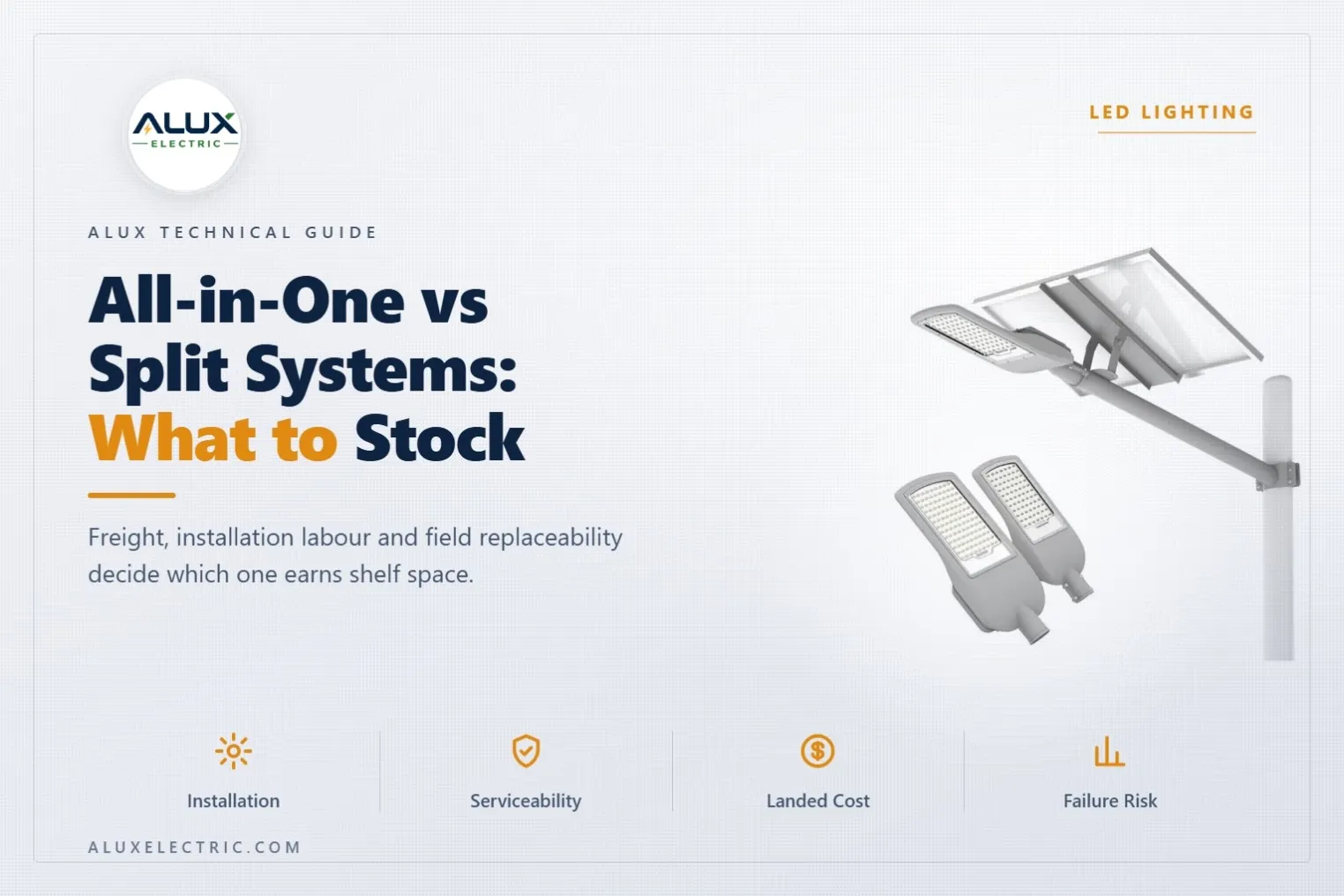
Every distributor building a solar street light range hits the same fork: put your money behind integrated all-in-one units, or behind split systems with a separate panel and battery. The two look interchangeable in a catalogue and are treated as interchangeable in most tenders, but they behave very differently once they leave your warehouse. This guide compares them on the four things that actually hit your margin and your customer's site: freight, installation, serviceability and failure risk.
What the two configurations actually are
An all-in-one unit carries the LED module, the controller, the battery and the panel in a single housing that mounts on top of the pole. Everything is wired and tested at the factory, so the installer lifts one box onto one bracket. A split system separates those blocks: typically a lamp head with its own optics, a panel mounted on its own arm or bracket, and a battery in a separate box - often pole-mounted or buried at the base - joined by field-made cable runs. Both approaches are legitimate; they suit different projects, different labour markets and different after-sales models.
Freight and landed cost
Volume is the deciding factor here, and it cuts both ways. An integrated unit packs into roughly one carton per pole, which simplifies packing and reduces the number of pieces to track - but that carton is bulky, and the awkward shape can waste pallet space. Split systems ship as several flatter packages, which often stack more efficiently, but multiply the handling cost and the number of cartons that can go missing on a project site.
Before you commit, price both configurations to the same destination with the same incoterm, including packaging dimensions rather than just weight. The comparison frequently reverses once volumetric charges are applied, and it is the single easiest place to lose margin on a container.
Installation labour and skill
On site, integrated units usually win on time and on skill requirements: one lift, one bracket, a handful of bolts, no field wiring to get wrong. Where labour is expensive, unionised or scarce, that advantage is decisive, and it is also why rental and temporary installations tend to favour them. Where labour is cheap and plentiful, the cost difference narrows and the other factors take over.
Split systems take longer: the panel must be oriented and tilted correctly, the cable runs must be made off and protected, and the battery enclosure has to be sited and secured. That extra time buys you something important, though - the installer can aim the panel independently of the lamp direction, which matters on roads where the best solar orientation and the required light distribution do not line up.
Serviceability and what happens when something fails
This is where the two configurations diverge most, and it is the question to ask before you sign a supply agreement rather than after the first warranty claim. In a split system, a failed battery or a damaged panel can usually be replaced as a single part, on site, without touching the luminaire. In an integrated unit, the same failure often means removing the whole head from the pole and returning or stripping it, because everything shares one housing.
Think about who absorbs that cost in your market. If you or your customer holds the warranty, a design that lets a technician swap the failed block in twenty minutes instead of replacing the whole fixture can be worth more than the freight saving on the other side of the ledger. Confirm with your supplier which sub-assemblies are available as spare parts, at what price, and for how long after the order - that answer should drive which configuration you lead with.
Failure risk in the field
Both configurations fail most often in the same places: the battery, the charge controller, and water ingress. Integrated units concentrate all three in one enclosure mounted at the top of the pole, which means higher ambient temperature around the battery in hot climates and one point of entry if the seal degrades. Split systems can put the battery lower down the pole or below ground, where it runs cooler and is easier to inspect - but they add connectors, glands and cable runs, each of which is another potential ingress point if installation quality is poor.
Neither is inherently more reliable. What decides it is build quality at the seals and the terminations, and how carefully the system was installed. Ask to see the ingress protection testing behind the rating quoted, and check what happens to the warranty if an installer does not use the supplied glands.
Head-to-head
Factor | All-in-one | Split system |
Packing / freight | One carton per pole, bulky; check volumetric | Several flatter cartons; more pieces to track |
Installation time | Short: one lift, few bolts, minimal wiring | Longer: panel aiming, cable runs, battery siting |
Panel orientation | Fixed by housing; limited adjustment | Independent of lamp direction |
Failure replacement | Usually whole-head swap or return | Battery, panel or driver swapped individually |
Battery temperature | Sits in the luminaire, hotter in summer | Can be mounted lower or below ground |
Best fit | Fast rollouts, high labour cost, temporary sites | Long-life projects with local service capability |
How to decide what goes on your shelf
Three questions settle it. One: what does installation labour cost in your market, and who pays for it? Two: who carries the warranty, and can they replace a sub-assembly in the field? Three: how will you handle spare parts in year three, when the first batteries come due? Distributors serving contractors who value speed usually lead with integrated units and keep split systems for engineered projects. Distributors with their own service crews often do the reverse, because field-replaceable parts protect their margin.
There is also a middle path worth considering for larger ranges: stock integrated units for the fast-moving general-purpose wattages, and offer split systems for project tenders where orientation and serviceability are specified. That keeps the catalogue broad without doubling your inventory depth.
Next step
Tell us your market, typical project size and whether you or your customer carries the warranty. We will recommend which configuration to lead with, quote both to the same terms, and confirm which spare parts are available for each - before you commit shelf space either way.
Talk to our team on the contact page: /contact-us/ - or message us on WhatsApp for a faster reply.