
Oct 13, 2026News & Insights
SJTW vs SOOW: Outdoor Cord Jacket Guide
SJTW vs SOOW: what the letters mean, PVC thermoplastic vs rubber thermoset, temperature and oil resistance, and which jacket fits your outdoor program.
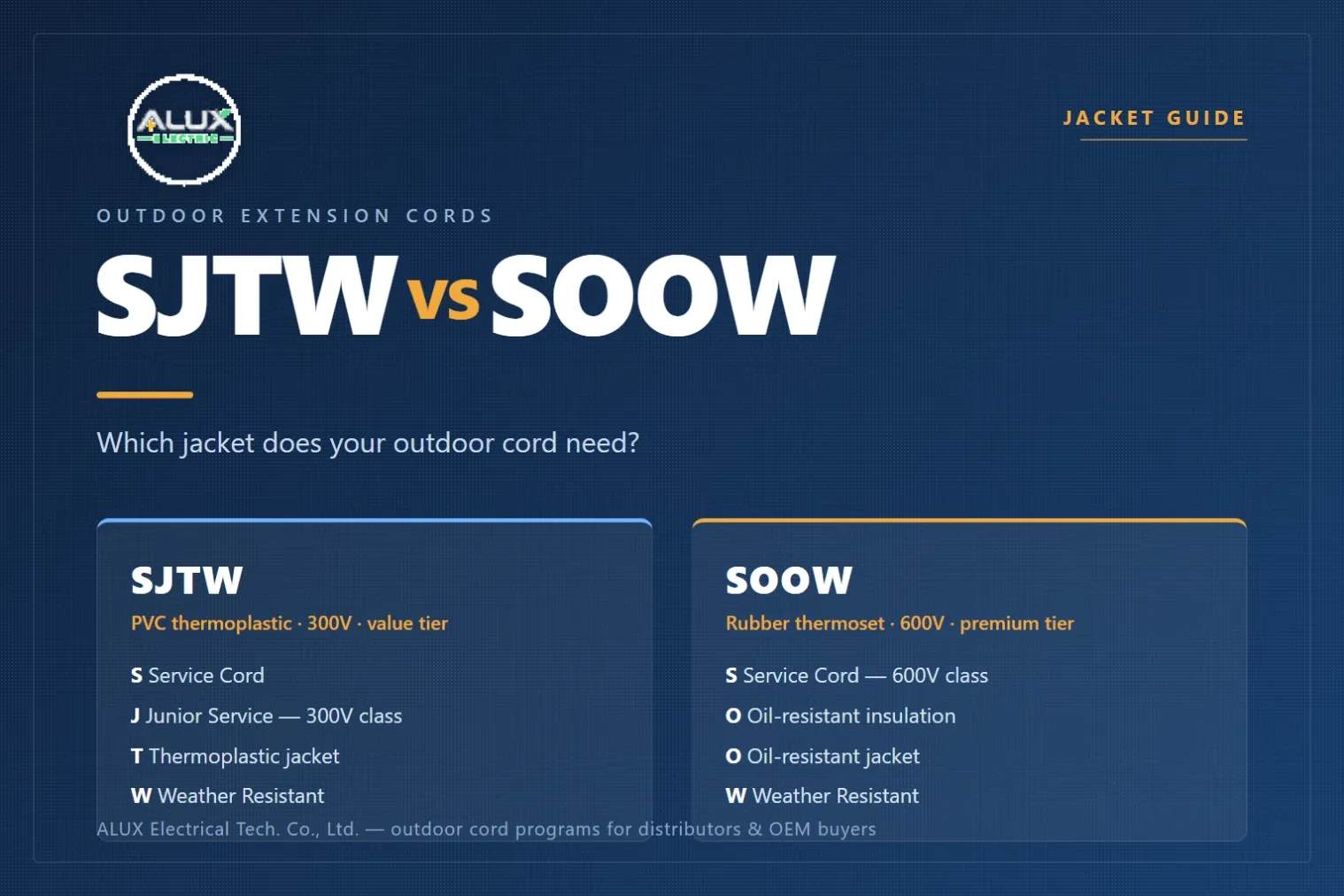
Two of the most common letter codes printed on outdoor extension cords - SJTW and SOOW - sit at opposite ends of the cost and performance spectrum, and they are not interchangeable. SJTW is a 300 V PVC thermoplastic jacket built for general outdoor use; SOOW is a 600 V rubber thermoset jacket built for oil-soaked, abraded, frequently dragged industrial service. Picking the wrong one either wastes money on a cord that is tougher than the job needs, or puts an under-rated jacket where it will crack, stiffen or fail.
This guide decodes both designations letter by letter, compares the two jackets across the properties that actually matter outdoors (temperature, flexibility, oil resistance, voltage class), and tells you which one fits household retail, jobsite and OEM programs. It is written for distributors, retailers and OEM buyers comparing outdoor cord programs.
What the Letters Mean: SJTW vs SOOW
The letters printed on a cord jacket are not a brand - they are a standardized designation. Read them off any sample.
- SJTW - S = Service Cord, J = Junior Service (300 V class), T = Thermoplastic jacket, W = Weather Resistant. A PVC-based jacket: the value tier for outdoor cords.
- SOOW - S = Service Cord (no J, which raises it to the 600 V class), O = Oil-resistant insulation, O = Oil-resistant jacket, W = Weather Resistant. A rubber (thermoset) jacket: the premium tier.
Three differences fall straight out of the letters:
- Voltage class. The J in SJTW caps it at 300 V. SOOW has no J, so it is rated for 600 V service. For a household 15 A / 125 V (1875 W) extension cord this does not matter - both are well above the working voltage. For industrial equipment and tooling power, the 600 V class is the reason SOOW exists.
- Jacket material. T = thermoplastic (PVC, which melts and re-forms under heat). The double-O in SOOW means a thermoset rubber compound that is oil-resistant both inside and out. Thermoset does not re-melt.
- Oil resistance. SJTW does not carry an oil-resistance letter. SOOW carries two. On a jobsite where cords lie in oil, fuel and grease, that is the single most consequential difference.
Jacket Material: Thermoplastic vs Rubber
The jacket is the layer that takes the abuse - sunlight, abrasion, oil, cold. The material decides how it behaves.
SJTW (PVC thermoplastic). Affordable, weather-resistant, and durable enough for general outdoor exposure. PVC stiffens in cold weather, softens in extreme heat, and is not built for sustained contact with oil or fuel. It is the right jacket for a household or retail outdoor cord that lives on a reel in a garage and gets pulled across a lawn.
SOOW (rubber thermoset). Compounded to stay flexible across a wider temperature range, to resist oil on both the insulation and the outer jacket, and to take the kind of dragging, kinking and abrasion that happens on jobsites and around industrial equipment. Thermoset rubber does not re-melt - it is cured once and holds its properties. That performance comes at a higher material and processing cost.
The rule of thumb: PVC (SJTW) is the value tier, rubber (SOOW) is the premium tier, and TPE (SJEOW) sits between them. If your program is household retail, SJTW is the right call. If your program is industrial, jobsite or oil-exposed service, SOOW is the right call - and trying to save money by substituting SJTW there is where field failures start. (For the mid-tier comparison, see our guide on SJEOW vs SJTW: Is the Extra Cost Worth It?.)
Temperature and Flexibility Compared
Two properties separate these jackets sharply outdoors.
Low-temperature flexibility. PVC stiffens as the temperature drops. A PVC-jacketed SJTW cord that is supple at room temperature can become stiff and hard to coil in winter cold, and a stiff jacket is more likely to crack if it is kinked or driven over. Rubber thermoset SOOW stays flexible across a wider cold range - which is exactly why cold-climate and jobsite programs specify SOOW (or its TPE sibling SJEOW) rather than PVC.
Heat and abrasion. SOOW holds its properties under sustained heat and abrasion better than PVC. For a cord that will be dragged across concrete, run over by carts, or parked next to hot equipment, that is the difference between a jacket that lasts the season and one that scuffs through.
Which One for Construction Sites?
For construction sites, SOOW is the better choice. Cords on a jobsite are exposed to movement, weather, abrasion, oil, fuel and harsh conditions - exactly the service SOOW's double-O rating is compounded for. A PVC-jacketed SJTW cord will work for light, temporary, indoor-adjacent duty, but it is not the right jacket for sustained jobsite abuse, and most site safety specifications will not accept it for primary runs.
(The same logic applies to SJEOW - our SJEOW vs SJTW guide covers when the TPE mid-tier is the more practical pick than full rubber SOOW.)
Which One for OEM and Retail Programs?
The choice flips for household and retail programs.
For a household or retail outdoor cord - a 25 ft, 50 ft or 100 ft NEMA 5-15P grounded cord at 15 A / 125 V (1875 W), built in 12/3 or 14/3 AWG - SJTW is the right jacket. It is weather-resistant, it meets the duty cycle of household and light outdoor use, and it keeps the unit price where a retail program needs it. Paying for an SOOW jacket here is spending money on performance the application does not use.
For OEM and private-label programs, the decision is the same logic applied to your market:
- A household/distributor retail line - SJTW. (See our 25 ft 12/3 SJTW outdoor cord and 14/3 SJTW 3-outlet cord on the products page for standard configurations.)
- An industrial/jobsite/equipment line - SOOW.
- A cold-climate or frequently-handled line where rubber is over-specified but PVC is not enough - SJEOW as the middle ground.
When you spec a program, match the jacket to the service the cord will actually see, not to a "best jacket" ranking.
SJTW vs SOOW at a Glance
Property | SJTW | SOOW |
Letters | S-J-T-W | S-O-O-W |
Voltage class | 300 V (Junior) | 600 V |
Jacket material | PVC (thermoplastic) | Rubber (thermoset) |
Oil resistance | Not rated | Oil-resistant insulation + jacket |
Weather resistance | Yes (W) | Yes (W) |
Cold flexibility | Stiffens in cold | Stays flexible in cold |
Cost tier | Value | Premium |
Typical program | Household retail, general outdoor | Jobsites, industrial equipment, oil-exposed service |
(Both designations are printed on the cord jacket - read them off any sample before you quote or compare.)
FAQ
Is SOOW better than SJTW?
SOOW is built for harder service than SJTW - oil resistance, 600 V class, better cold flexibility and abrasion behavior. "Better" depends on the job: SOOW is the right choice for industrial and jobsite programs, but it is over-specified and over-priced for a household retail cord where SJTW is the correct jacket.
Can I use SJTW instead of SOOW?
In light-duty outdoor environments, yes. SJTW can replace SOOW for household and general outdoor use. For industrial, oil-exposed, cold-climate or frequently moved applications, SJTW is not a suitable substitute - its PVC jacket will stiffen, abrade or fail where SOOW is specified.
Why is SOOW more expensive than SJTW?
SOOW costs more because it uses a thermoset rubber compound (not PVC), is rated for 600 V service, and carries oil resistance on both the insulation and the jacket. The rubber compounding and curing process is more involved than PVC extrusion, and the performance is higher across temperature, oil and abrasion.
Is SOOW suitable for outdoor extension cords?
Yes. SOOW is weather resistant (the W) and is commonly specified for outdoor extension cords in industrial and jobsite service where the cord will be exposed to oil, abrasion, cold and movement. For household outdoor cords, SJTW is the more appropriate - and more economical - jacket.
Which is better for construction sites?
SOOW. Construction sites expose cords to movement, weather, abrasion, oil and harsh conditions - exactly the service the double-O rating and rubber thermoset jacket are compounded for. SJTW is not the right jacket for sustained jobsite duty.
Get a Bulk Quote
If you are building an outdoor cord program and need to compare SJTW, SJEOW or SOOW configurations across 12/3 and 14/3 AWG, 25/50/100 ft and NEMA 5-15P - request a quote and tell us the market, the jacket and the volumes. We quote per program with the certification scope confirmed in writing during the RFQ.