
News & Insights
Cam-Lock Sizes: 150A, 200A or 400A?
Cam-Lock sizing follows the cable, not the label. How 150A, 200A and 400A differ in conductor range, body type and panel fit - and what the datasheet omits.
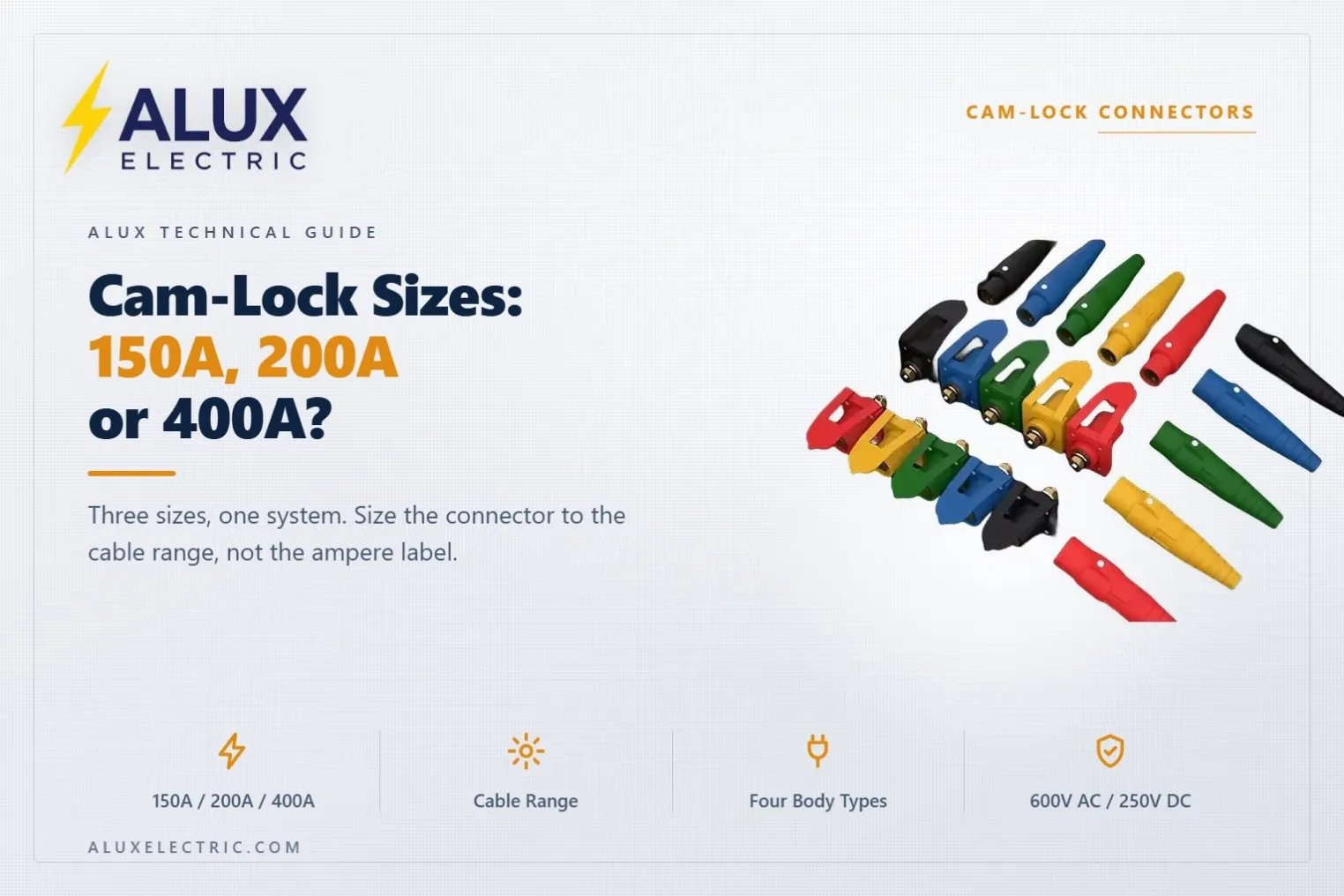
A rental company in Manila stocks 400A cam-lock bodies. A generator packager in Rotterdam orders 150A. Both are building temporary power distribution, and both will tell you their size is the standard. It is not a standard, it is a habit - and the habit is usually inherited from whichever distro box the company bought first. The number on a cam-lock connector describes the contact system, not the load your site will actually put through it.
Three limits hide behind one number
A cam-lock joint has to satisfy three separate limits, and only one of them appears in the part name. The first is the rated current of the contact pair. The second is the cable cross-section the body can accept and terminate. The third is the protective device upstream, which decides when the circuit is actually disconnected. A connector that is larger than the circuit is expensive but harmless. A connector that is smaller than the circuit is a fault waiting for a busy night.
Size | Rated current | Cable cross-section | Where it is usually specified |
150A | 150 A max | 10-25 mm2 | Branch feeds, small distro outlets, single-phase tie-ins |
200A | 200 A max | 16-35 mm2 | Mid-size distribution, generator tails, sub-mains |
400A | 400 A max | 50-95 mm2 | Main feeders, large distro incomers, stage mains |
All three sizes share the same electrical ceiling of 600 V AC or 250 V DC, the same copper alloy contact, screw termination and a double-cam engagement that locks with a 90-degree turn. The housing is rated from -40 to +90 degrees C. What changes between them is the metal: how much current the contact pair can carry, and how much copper the body can take in.
The cable range decides more than the ampere figure
This is where most oversizing happens. A 400A body accepts 50-95 mm2 cable. If the feeder was designed around 35 mm2, the 400A connector will not terminate it properly - the conductor will not fill the barrel, the screw will not clamp a solid stack, and the joint will run warmer than the cable behind it. The installer then either forces the fit or drops to a smaller body, and the paperwork no longer matches the hardware.
Run the calculation from the cable up, not from the connector down. Fix the cross-section from load current, volt drop over the actual run length and the installation conditions, then choose the connector size whose range contains that cross-section. If two sizes both accept the cable, choose the smaller one: it is cheaper, it fits the panel cut-out you already have, and it keeps the joint honest about the load.
Same system, four bodies
A cam-lock feeder is not one part, it is a chain of four body types: male plug, female plug, male panel socket and female socket. The cable end carries a male plug at the source and a female plug at the load. The panel carries sockets, so the equipment can be fed or looped through without opening it. Buyers who order only plugs discover the gap when the distro box arrives, because a plug cannot be bolted into a panel.
Sort the bill of materials by function before you price it: cable-end plugs, cable-end connectors, panel sockets, and caps for the outlets that will be unused. Mating is straightforward within one size and one product family - a 400A plug does not mate with a 200A socket, which is the mechanical reason the sizes can safely share a site. Compatibility between different manufacturers is a separate question and should be confirmed on samples, not assumed from the ampere rating.
Colour identifies a circuit, it does not protect it
Cam-lock bodies are supplied in five housing colours - yellow, green, red, blue and black - so that a multi-cable feeder can be traced by eye. The mapping is a project convention, not a fixed rule. North American temporary power commonly uses green for earth, white for neutral and black, red and blue for the three phases; European projects often work to brown, black and grey. Neither convention survives contact with a site that has its own panel schedule.
The practical rule is that colour is a label, not an interlock. It helps a technician grab the right cable in a dim venue, and it helps an inspector read a feeder at a glance. It does not stop anyone plugging the wrong phase into the wrong socket. Publish the colour map on the distro drawing, label the cable ends to match, and treat the drawing - not the housing - as the authority.
What the datasheet does not tell you
Two things are usually missing from a cam-lock conversation, and both matter outdoors. The first is ingress protection. The connector itself is not sold with an IP rating in the way an IEC 60309 plug is; the sealed enclosure, the panel gasket and the weather caps do that work. If the distribution box will stand in rain, specify caps for every unused outlet and confirm how the panel is sealed. The second is duty. These are not switches. A cam-lock joint should be made and broken with the circuit isolated upstream, not used to interrupt a live load.
Connect the earth first, break it last
On a multi-pole feeder built from single-pole connectors, the sequence is not cosmetic. When making up, connect the protective earth first, then neutral, then the phases. When breaking down, reverse it: phases, neutral, earth last. The reason is that the earth path should never be the last thing standing between a fault and a person, and it should never be the first thing removed while the conductors are still live.
This only works if the cables are identifiable, which brings the colour map back into the conversation. It also only works if the person making up the feeder has been told the sequence - a cam-lock feeder is assembled by hand, one cable at a time, and there is no keying to prevent a mistake. If your installers are contractors rather than staff, put the sequence on the drawing as well.
Five things to put in the RFQ
Item | What to state |
Current and voltage | Required amperage per circuit and system voltage, AC or DC |
Cable | Cross-section in mm2, conductor class and outer diameter |
Body types | Quantity of male plugs, female plugs, male panel sockets, female sockets |
Colour map | Which colour is earth, neutral and each phase on this project |
Accessories | Weather caps, protective caps, panel fixings, spare locking screws |
Adding the cable diameter to the RFQ is the single change that removes most back-and-forth. Two cables with the same cross-section can have very different outer diameters, and the strain relief on a cam-lock body is sized for the cable jacket, not the copper. If the diameter is not known yet, send the cable datasheet instead of the nominal size.
FAQ
Can a 400A connector be used on a 200A circuit? Mechanically yes, provided the cable sits inside the 50-95 mm2 range. It is simply larger and more expensive than the circuit needs, and it makes the panel bigger than necessary. The protective device still decides when the circuit trips.
Do 150A and 400A cam-locks mate? No. The three sizes use different contact and shell dimensions, which is why a mixed site can stock all three without confusion at the connection point.
Are cam-lock connectors waterproof? The connector is not supplied with an IP rating. Outdoor protection comes from the enclosure, the panel seal and the caps fitted to unused outlets, so it has to be specified as part of the distro box rather than assumed from the connector.
ALUX supplies single-pole cam-lock connectors in 150A, 200A and 400A, in male plug, female plug, male panel socket and female socket bodies, with five housing colours and OEM marking. If you are building a feeder or a distro box and want the cable range checked against your design, send the circuit schedule through our <a href="/contact-us">contact page</a>. For the wider question of when single-pole connectors make more sense than a keyed IEC 60309 system, see <a href="/posts/cam-lock-vs-iec-60309-b2b-connector-guide">Cam-Lock vs IEC 60309</a>; for cable and connector selection across industrial equipment, see <a href="/posts/how-to-choose-the-right-power-cord-and-connector-for-industrial-applications">choosing the right power cord and connector</a>.